



The Destrier combines the Bolide’s 1,600-hp W16 powertrain with a radically low form
Bugatti has unveiled the Destrier, its third Solitaire commission, at the Pebble Beach Concours d’Elegance. Named after the most prized type of war-horse used by medieval knights, the Destrier employs the Bolide’s carbon-fibre monocoque, though with a markedly different approach to the extreme performance car’s design.

Bugatti says the Destrier was conceived as a design-first sculpture, with its proportions and craftsmanship taking precedence over outright performance. At first glance, we see a wider grille than that of the Bolide, though the front seems otherwise restrained. The side introduces a fresh interpretation of Bugatti’s signature “C-line” which, rather than running uninterrupted along the body, pauses ahead of the front wheel before continuing towards the horseshoe grille.
The car’s stance is arguably its defining feature. Standing just one-metre tall, the Destrier is lower than any other Bugatti model. Its cabin sits extremely low between the front wings, while the bodywork behind the doors narrows into a pronounced “waist” before expanding over the rear wheels into broad rear haunches. Its 20-inch front and 21-inch rear wheels–a digression from the Bolide’s 18-inch units flanked by prominent aero elements–are surrounded by minimal bodywork. At the rear, an integrated wing draws inspiration from the Chiron Profilée.
Underneath, however, the Destrier retains the Bolide’s complete powertrain. The quad-turbocharged 8.0-litre W16 produces 1,600 hp, making it one of the most powerful applications of Bugatti’s iconic engine.
Bugatti sees the Destrier and Bolide as two radically different interpretations built around the same underlying architecture, with an engraved plate above the windscreen, depicting both the Type 57G Tank and Type 57SC Atlantic, reinforcing the connection. For reference, Bugatti’s Type 57 chassis historically provided the basis for both the Type 57G and Type 57C ‘Tank’ racing cars, which won the Le Mans 24 Hours in 1937 and 1939, and the Type 57SC Atlantic, arguably the “most beautiful car” of all time.
As an aside, another similarity which the Destrier has with the Atlantic comes from its “Sapphire Celeste” colourway, a bespoke multi-layered blue with diamond-inspired elements, contrasted by the polished aluminium. The colour references the Type 57SC Atlantic chassis 57591, known as the ‘Pope’ Atlantic, which was originally finished in blue before being repainted black.
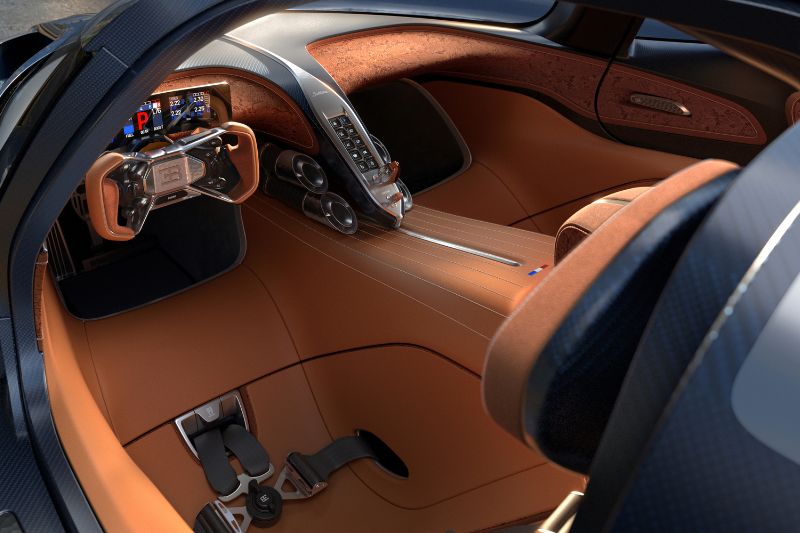
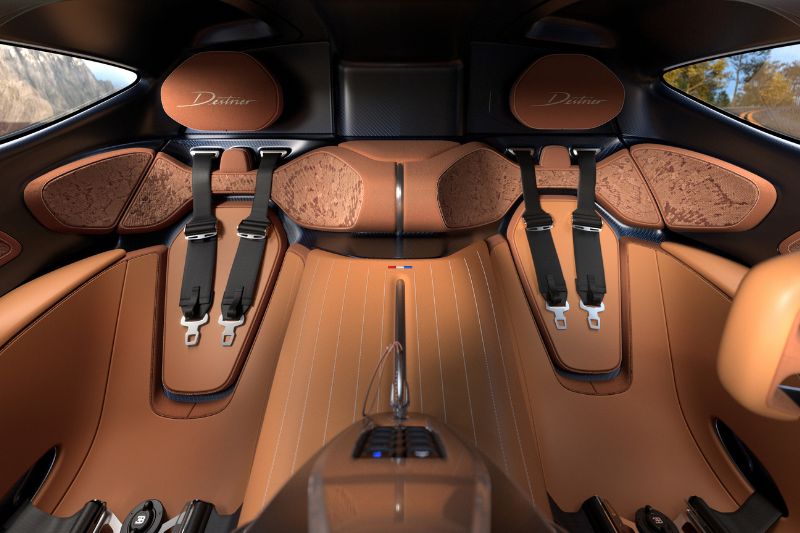
The cabin represents a significant departure from the Bolide’s stripped-back motorsport interior. Here, Bugatti has created a bespoke environment using leather and nubuck in the warm “Ambre Voyageur” brown shade, alongside a 3D-knitted technical textile. The knitted material incorporates copper yarn and a circular halo-line pattern, while contrasting stitching highlights the geometry of the cabin. The hammered-metal finish is repeated on the door opener, air vents, steering-wheel hub and entry plate. And finally, a small French flag is positioned at the centre of the cabin, as a call-back to Bugatti’s origins.

Ultimately, though universally appealing, the very idea of a Bugatti, much less a one-of-one example, can be achieved by a rarefied few. The rest of us mere mortals, meanwhile, can only save up enough to hedge our bets on electrification, as the no-lag acceleration of an electric motor in the future is the closest thing to uber-powerful machines such as the Destrier, today.





















Leave a Reply