


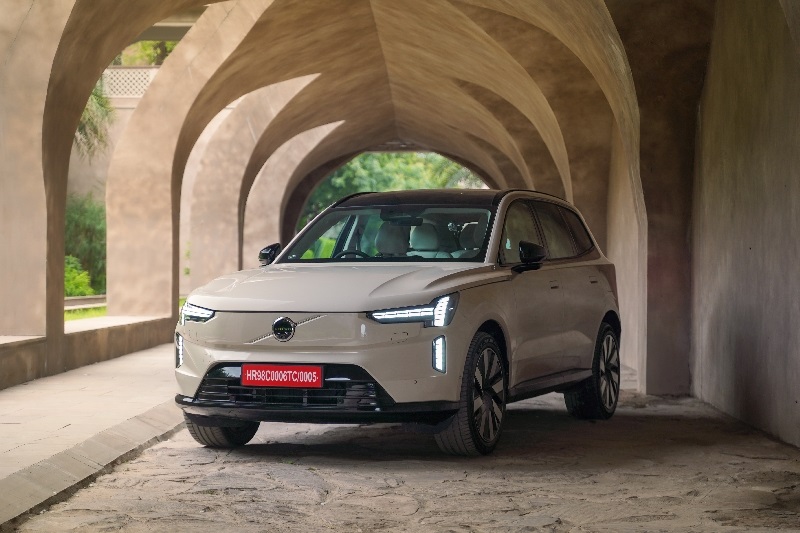
The all-new Volvo EX90 represents the pinnacle of the Swedish automaker’s line-up as the most technologically advanced vehicle ever offered in India.
Volvo is a brand synonymous with safety. A five-star rating with high scores across all of the stringent Euro NCAP categories has been a given for some time. In fact, some Volvo crash-test procedures, such as the side pole impact test, have anticipated, even influenced Euro NCAP safety guidelines. And they introduced the three-point safety belt back in 1959, patent-free in the interest of safety. A lot of time has gone by. Volvo will celebrate its centenary next year. While the values seem to have been retained, the shift in the way things are done could not be more pronounced.
Now, my association with the Volvo brand goes beyond reviews, having worked at a dealership level in 2009—back when they had just two models in India: the S80 sedan and first-gen XC90 SUV. Those days, training sessions, drives, and museum experiences gave me more of an insight into their values and focal points. And that brings me to the EX90, the electric version of the globally popular XC90, the brand’s full-size three-row sport utility vehicle (SUV) first introduced in 2002, and to much acclaim. The “90” models are, after all, the top of their tree. We’ve seen the S90 sedan, V90 Cross Country estate, and the XC90 SUV thus far. This EX90 is the first of the electric 90s, with the ES90 set to arrive later.
Space, comfort, practicality, and safety—those are the values that defined the XC90. Exceptional in its first generation, yes, with its second-generation model, introduced on the Scalable Product Architecture (SPA) in 2015, moving to a more tech-first approach and offering a plug-in hybrid “TwinEngine” option. The all-electric EX90 here is based on the newer platform and isn’t the first model that Europe got. That was on a 400-volt architecture, and it’s now gone. This is the new model year 2027 EX90, which Europe now gets and which we’re among the first in the world to have a go in.
Globally, there are three: a single-motor RWD with 333 hp, a 456-hp twin-motor AWD, and a performance version of the latter with 680 hp. We get the 456-hp AWD version for India, and with a six-seat layout.
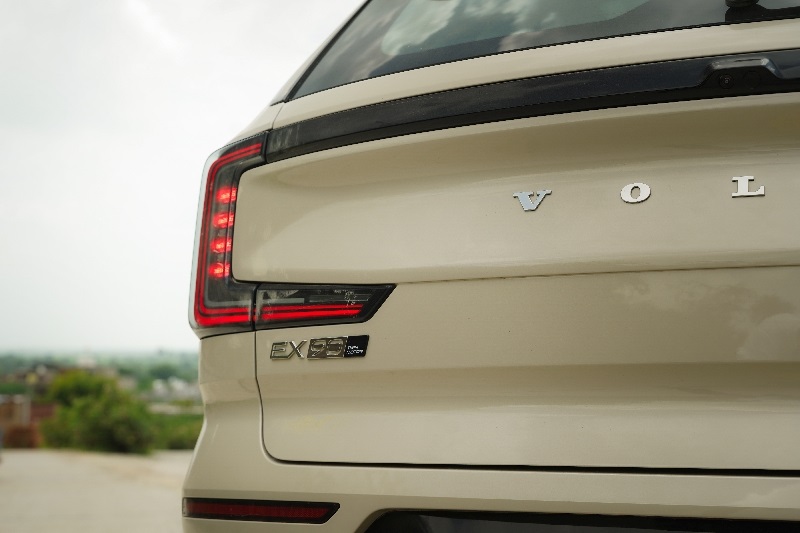
Exterior detailing shows quite a departure from the combustion-engine XC90 with a closed-off front face, with just the signature diagonal slat, new segmented LED headlights still showcasing the unique “Thor’s Hammer” (or Mjölnir), and daytime running lights (DRL). The EX90’s proportions are slightly more generous than the XC90’s, with a length of 5,037 millimetres, a width of more than two metres, and a height less than 1.75 metres, but on a similar wheelbase. The EX90 is Volvo’s first software-defined vehicle (SDV) and, needless to say, the focus was on the technology. Is it really that much of a step forward?
In terms of development and features, yes. It has more computing power than leading performance laptops: a multitude of 100-plus separate electronic control units (ECU) have been reduced to major central controlling units, with advanced NVIDIA processing units capable of 280 TOPS (trillion operations per second). Yes, it’s a glorified mobility gadget. Volvo, of late, has been putting more focus on in-car entertainment and connectivity, advanced autonomous safety tech, and the integration of Google in the primary interface than it has on actual driving and travelling—sort of makes sense considering a majority of urban drives and commutes involve being stuck in traffic for several minutes, and at times, hours. But we would experience only a little of that typical jam and head outside towards some raw country paths with a good dose of open highway around Fort Banwara, near the town of Sawai Madhopur in Rajasthan, about three hours south of Jaipur.
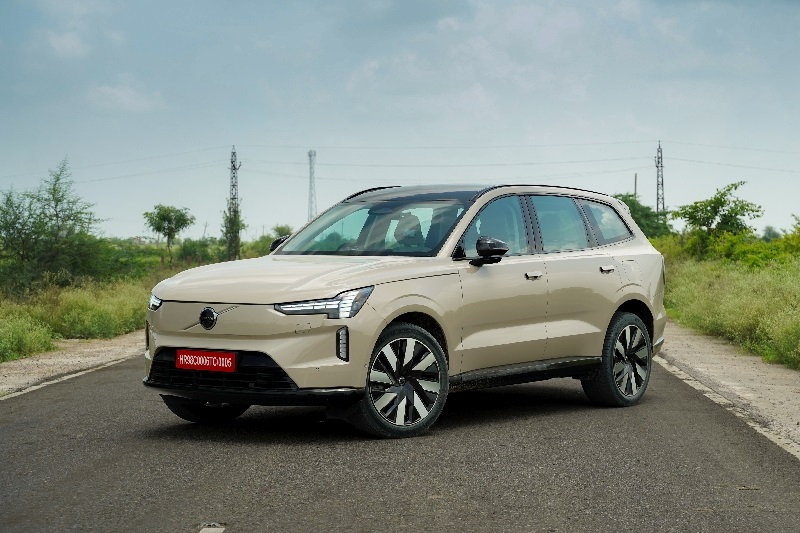
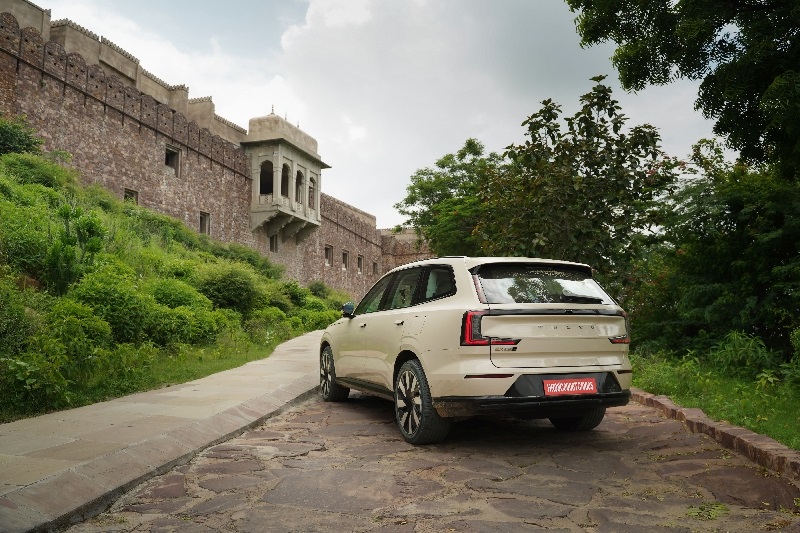
A brief preview the previous evening confirmed the variant and specification. For now, India gets one sole powertrain, the Twin Motor AWD, six seats, with second-row folding captain seats, and a powered 50:50 split-folding third row. There is the “Dawn” interior theme, and a choice of six exterior colours, including the “743” Sand Dune we have here—a long way down the paint finish list from the “487” Ember Black Pearl and “492” Savile Grey Metallic I used to configure my dream XC70 D5 AWD with some 16 years ago online.
On the EX90, I also noticed 21-inch wheels with mixed rubber: 265/45 tyres at the front and wider 295/40 tyres at the rear, all Michelin Pilot Sport EV. Bear in mind this version of the EX90 weighs 2,650 kilograms. I think 20s would have been ideal, but people want brighter, shinier, and much larger things these days, so who am I to argue?
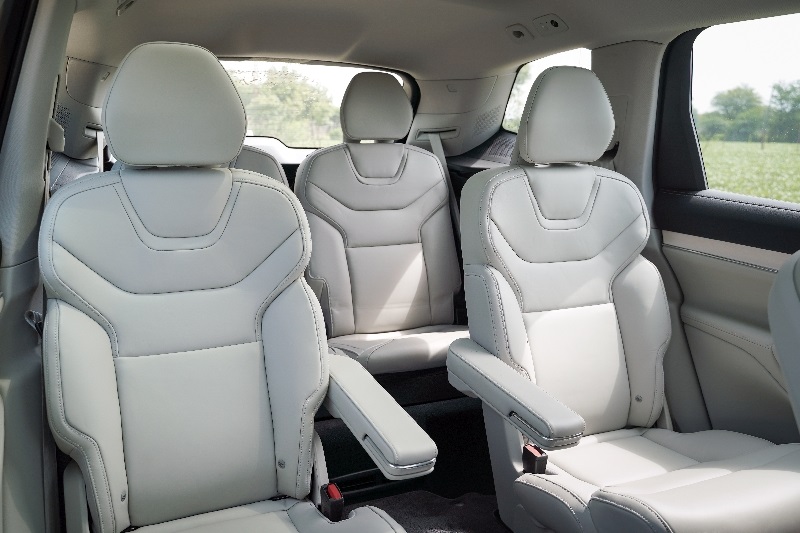
Getting into the rear seat first, I noticed a multi-angled take on the back-rest cushioning, the traditional tall head-restraint and a shapelier seat base but with a straighter finish towards the front—much like a premium leather couch. The front seats feature heating, ventilation, and a massage function, still incorporating the classic WHIPS (Whiplash Protection System) and with a full complement of airbags. The second-row captain seats offer supreme comfort and good knee-room. Air suspension is standard, and so is the “Active Chassis”, a much further evolution of the Active 4C (Continuously Controlled Chassis Concept) seen in the S80 V8 AWD sedan, which allows the EX90’s dynamic brain to adjust everything from the spring rate to the compression and rebound damping characteristics on the go in response to the terrain. What’s more, it can lower the vehicle by up to 40 millimetres, making for a ground clearance of between 210 and 250 mm. This helps peace of mind over rough surfaces and also makes loading easier.
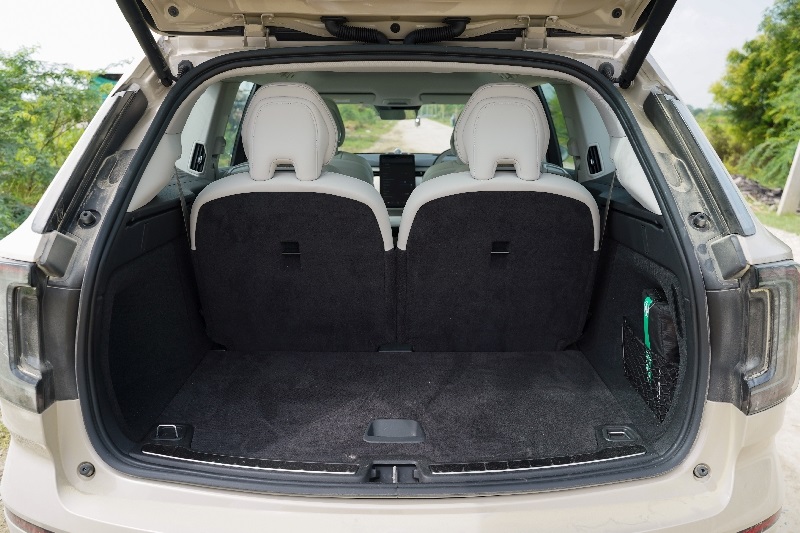
Speaking of loading, the EX90 offers a cargo volume of 324 litres with all seats up, 690 litres behind the second row with the third row down, and up to 2,082 litres with the second row folded, and loaded to the roof.
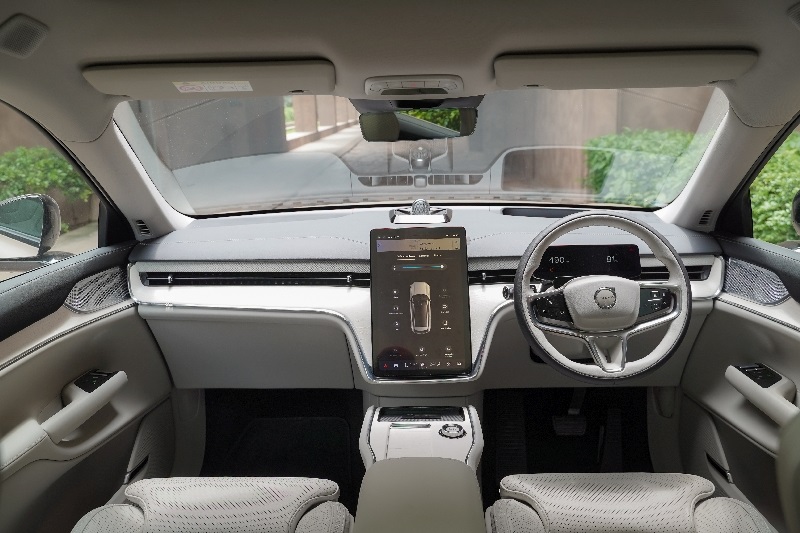
There is the thing about the “key”. A digital key, a credit-card-size piece of plastic, needs to be precisely positioned on the inset flush door handle to unlock (or lock) the vehicle. That means no proximity keyless access or remote locking as it is. However, that can be fixed by downloading the app and syncing one’s smartphone with the onboard user information system. Right, finally, I’m inside. There is a seemingly minuscule 9.0-inch widescreen driver information display mounted on the steering column, with the wiper stalk and drive selector popping out from its vicinity like appendages. There is a much larger 14.5-inch portrait-style tablet in the centre which gives access to most of the EX90’s functions, including adjusting the steering wheel position, wing-mirror position, seat heating and ventilation, and even opening the glove-box. Yes, it can quickly get quite annoying! Seat controls are rather intuitive, however, and the square knob can be pushed, lifted or twisted to adjust the slide, height, and recline, respectively.
The two-motor 335-kW (456-hp) set-up uses a more powerful rear motor and a supporting front motor. Volvo Car India didn’t share numbers, but going by what I looked up in the ES90, which this new EX90 is based on, there is a 135-kW (184-hp) front motor and a 200-kW (272-hp) rear motor. Both use single-speed transmissions. Power comes from a 106-kWh battery pack that offers an ICAT-rated range of 724 kilometres. Despite its 2,650-kg bulk, the EX90 can sprint from zero to 100 km/h in 5.5 seconds and get up to Volvo’s globally limited top speed of 180 km/h.
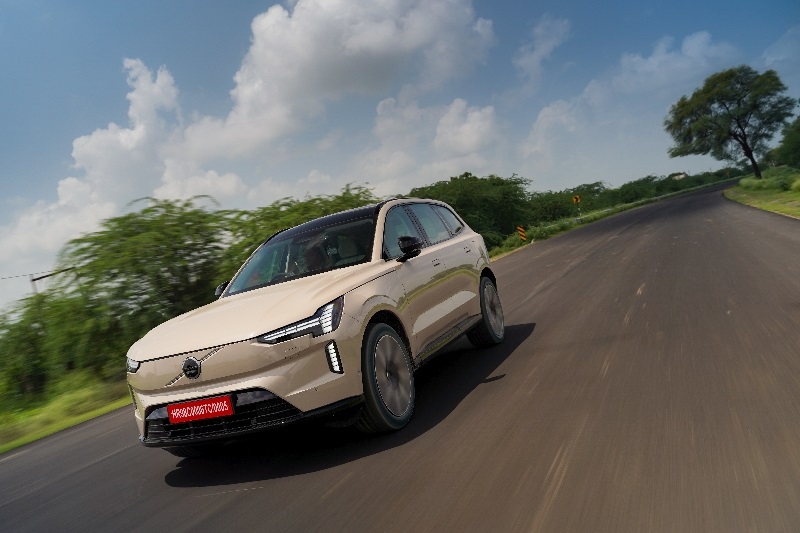
The EX90 is quick to set off, and the power delivery feels progressive and quite linear with no elastic-like stretchy feel accompanying it. The body feels planted and stable. The steering feel is excellent and very responsive, adding to driver confidence. The suspension settings can be switched among the soft, standard, firm, and auto active chassis presets for a pliant yet comfortable ride. It can handle changes of direction swiftly and confidently, with good brakes adding to the wholesome dynamic package feel.
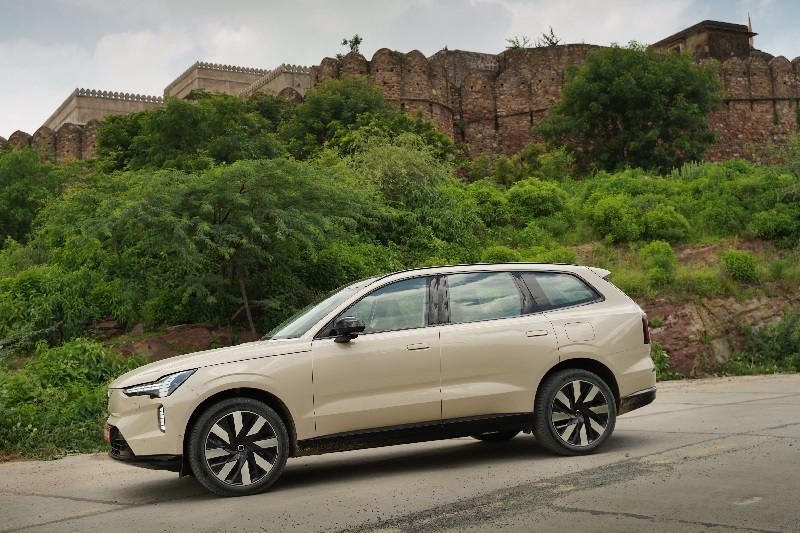
The 21-inch wheels with low-profile rubber are not ideal, though. Inside, the piano black centre speaker surround and the aluminium trim shine blindingly brightly with the noon sun right overhead; another case of form over function. That said, the centre speaker is one of 25 speakers of a 1,610-W Bowers & Wilkins premium audio system. Unlike the premium Dynaudio system in the old XC90 with a Gothenburg Concert Hall surround sound setting, this new system has an Abbey Road Studio setting along with more presets for sound quality.
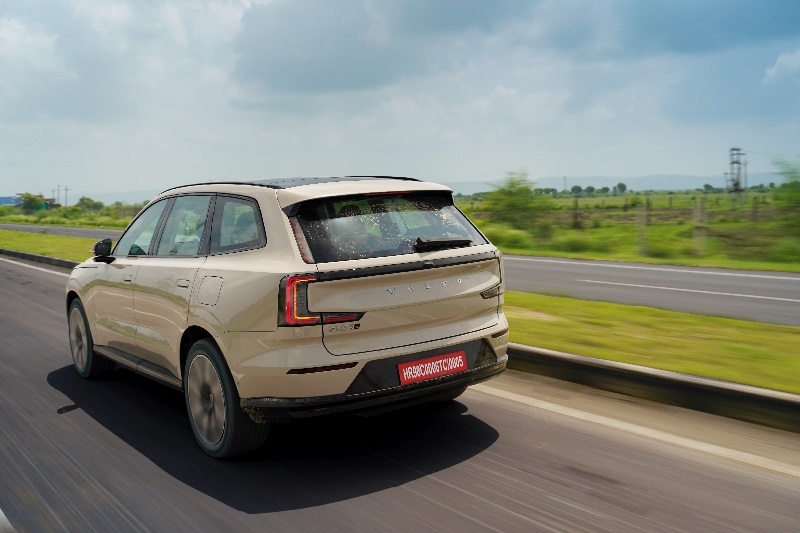
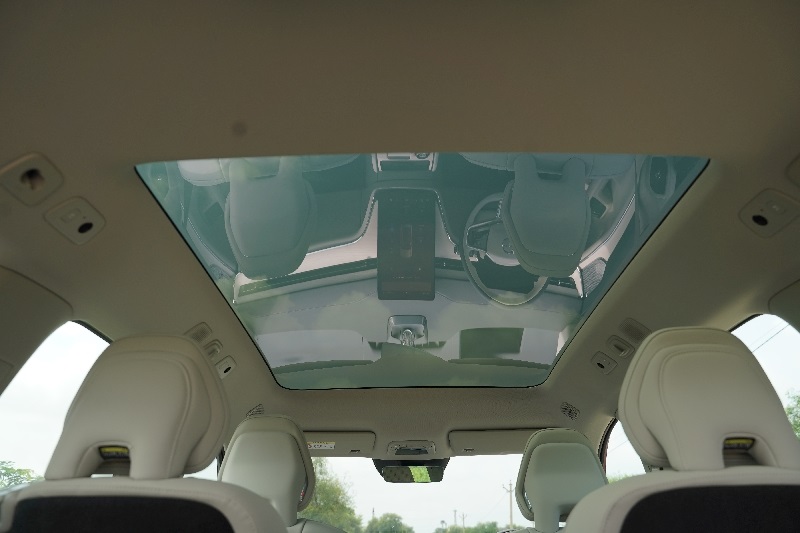
As I wrap up my rather short drive, I also need to mention the electrochromic roof which uses electricity to switch between clear and opaque—more like the Porsche Panamera’s than the deep ink-blue Maybach models have. A sun shade is available as an accessory, much needed in Rajasthan, among other places.
All said and done, the EX90 will appeal to those looking for a new-age EV with luxurious appointments, space, and gadgetry. Expect a tag of around Rs 1.50 crore or above, by my estimate. Pricing will be announced at the launch slated for early October, with deliveries beginning around the same time. Will it leave its Iron Mark after a first drive on those trying it out? Perhaps; but the old XC90 left a more indelible one on me than this one ever could. Evolution chooses strange new paths at times.
Story: Jim Gorde
Photography: Chirayu Gijare
Need to Know – Volvo EX90 Twin Motor AWD
Price: Rs 1.50 crore (estimated, ex-showroom)
Battery pack: 800-volt, 106-kWh
Max charge rate: 350 kW DC, 22 minutes (10 to 80 per cent)
Max power: 335 kW (456 hp)
Max torque: 670 Nm
Transmission: Single-speed automatic, front and rear, all-wheel drive
Suspension: Strut front, multi-link rear, active air suspension
Weight: 2,650 kg








Leave a Reply