


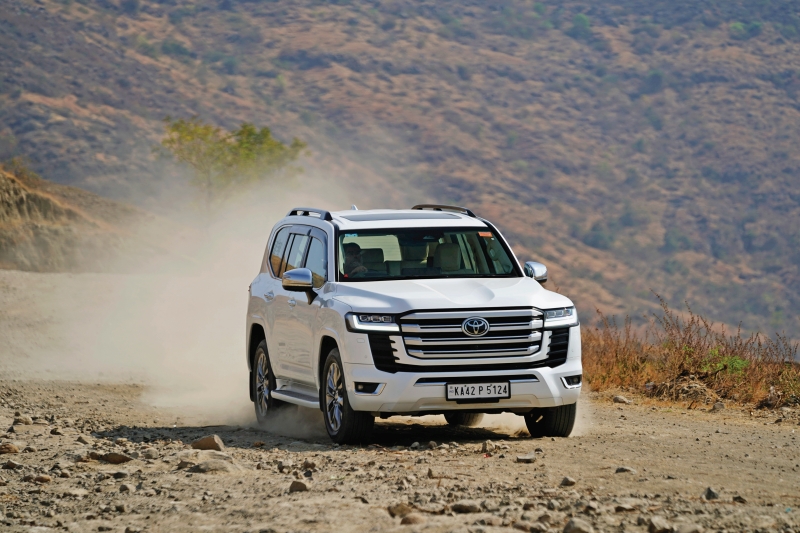
The Toyota Land Cruiser has stood the test of time like only a few others. Yes, it’s received some styling updates, including a large screen to go with the buttons, but one may wonder, ‘What’s an old-school tank like it doing in a new-age world like this?’
The Toyota Land Cruiser is an icon. From bashing through the Dakar Rally to dune-bashing on days off, the Land Cruiser has built an enviable reputation in respect of both capability and reliability—an extremely rare duo, matched by most of its siblings, such as the Hilux and the Tundra, while trouncing more expensive rivals on multiple, if not all, parameters. Now in the LC 300 form, it hopes to pick up where the LC 200 (and its big V8) left off. The size hasn’t changed, neither has the body, and the intent certainly has not either. However, what has undergone a change is underneath—the heart and the nervous system. And I will lead with that.
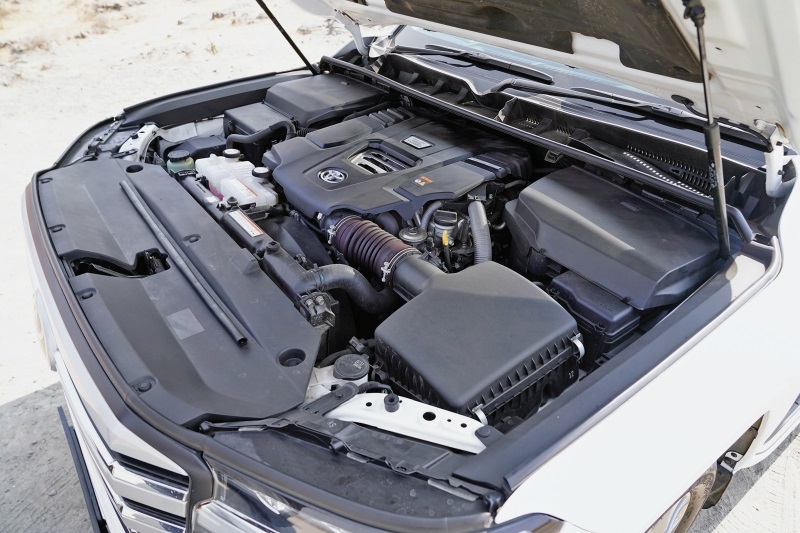
The switch from V8 to V6 applies globally with the 5.7-litre V8 atmospheric petrol and the 4.5-litre V8 turbo-diesel engines being replaced by 3.5- and 3.4-litre V6 engines, respectively. For context, this follows the move of Toyota’s Japanese flagship, the Century, which switched from a V8 to a V6 (and also from a sedan to an SUV body style in the process, before becoming a sub-brand recently). On paper, the figures exceed their predecessors’ by some margin. The new turbo-diesel is rated at 309 hp and 700 Nm, the latter of which peaks as low as 1,600 rpm. That’s up from the V8 diesel’s 285/265 rated horsepower and 650 Nm of torque. However, with a loosely 25 per cent shorter engine length and, presumably, crankshaft, which is also lighter, the depth or range of performance and the ease with which it does the same job are not the same. A new 10-speed automatic transmission adds more variables to that mix, but more on its performance later.
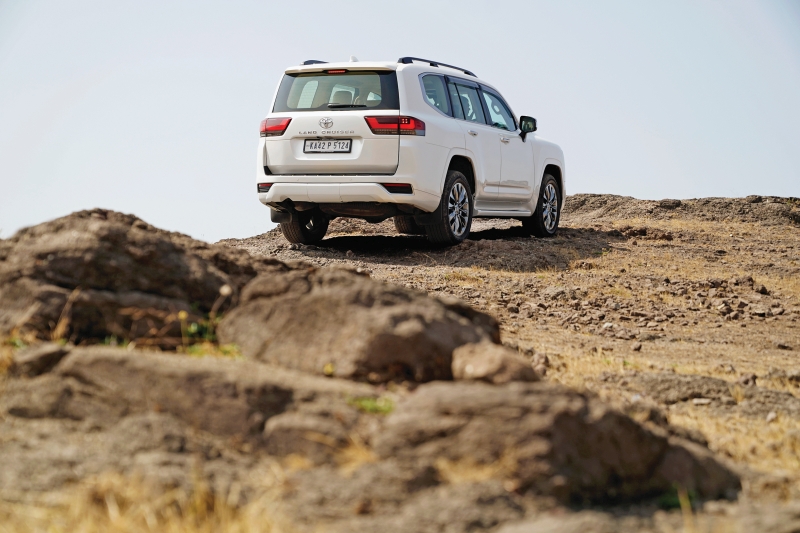
To behold, the LC 300 is a proper behemoth with a conquer-all persona, when one is not within the inner sanctum, able to be without fear in its confines. Heavy metal defines the LC just as much today as it did earlier. The ladder frame and its massive beams are visible from the rear wheel-arch without the need for even the slightest crouch. This is the ZX, the more luxurious of the two trims on offer—the other being the GR-S, the sportier of the two—and it gets 20-inch wheels with 265/55 Bridgestone Dueler A/Ts. The front grille features multiple slats and dashes of chrome, which were sparkling in the mid-day sun, offering a few twinkles of change from the pearl white body colour. The LED headlamps are new, too, as are the tail-light clusters; both have LED daytime lights, as is the norm these days.
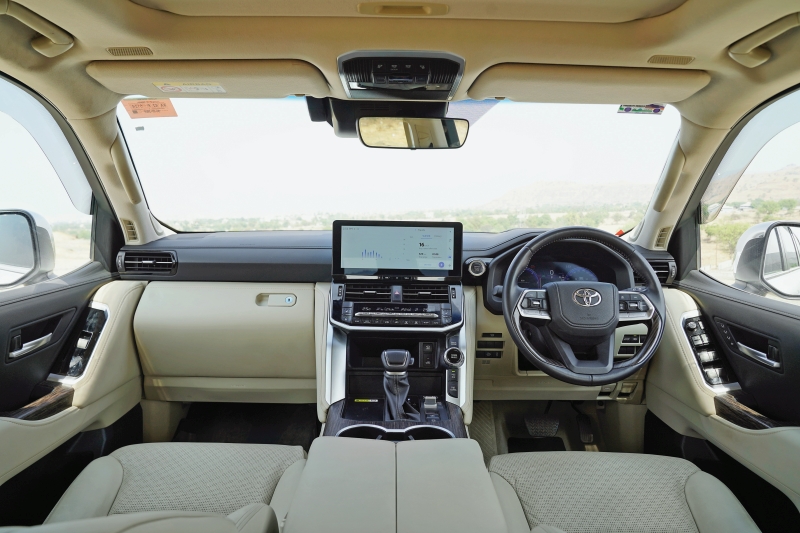
Step inside, and it feels just as old-school—big steering wheel, many buttons on the centre console, knobs and controls on the side and on the door panels, and a chunky gear selector on the centre console, with a 4×4 range switch, drive mode, and terrain mode dial alongside. There’s no stubby shift-by-wire nonsense in here. However, there is a rather large 12.3-inch centre touchscreen, a large single-pane electric sunroof with a thick sunblind, and a suite of advanced driver assistance systems (ADAS) with a full complement of active and passive safety features.
The safety suite includes radar-based adaptive cruise control, collision warning, autonomous braking, and even lane assist. However, with the LC 300 taking up more than an average lane’s width in many situations, it becomes mandatory to pay attention while driving this four-wheeled tank across town. Yes, at first it seems a bit overwhelming. It’s shorter in length than an Audi Q7 or even a Toyota Hilux, but its towering presence and, perhaps, even more towering reputation speak more than its sub-five-metre length. It is also very tall. At 1,955 millimetres high with a 230-mm ground clearance, it is significantly taller than most other luxury crossover SUVs with reactive all-wheel-drive systems. Once on the move, however, its capabilities slowly settle into my system.
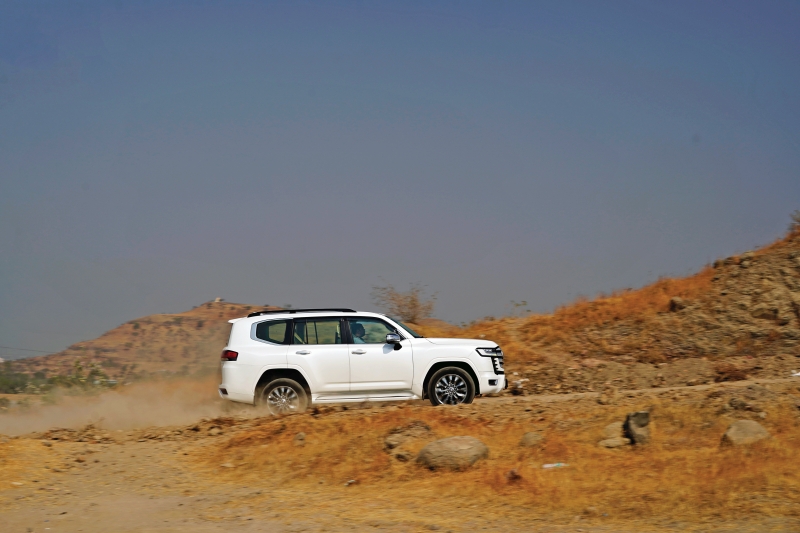
The LC 300 has some roll, but it’s not overly pronounced, except in some tight bends. The steering feel is good, too, with a precision that seems uncharacteristic of its size and 2,630-kg bulk. The V-shape of the bonnet surface is more evident from inside the cabin looking out than it is standing in front of the thing. What took me by surprise were the brakes. They first caused a few hair-raising moments once momentum built up, before a more-than-expected pressure of the foot reined things in without any alerts from the collision avoidance system. I underestimated both how quickly the LC 300 can get a move on and how much force it needed on the brakes to not move that quickly any more.
The ride is what sets it apart. The soft-ish suspension is aided by the adaptive variable system and a selection of drive modes from Eco, Comfort and “Normal” *eye roll* to Sport, Sport S, and Custom. I was mostly in the “Normal” mode, which was as normal for a five-metre-long, 2.6-tonne, ladder-frame SUV as it could get. There were judders over some bad patches and rumble strips at low speeds, but pick up the pace and the LC 300 simply floated over all surfaces, from undulations and no-road sections, without a second guess.
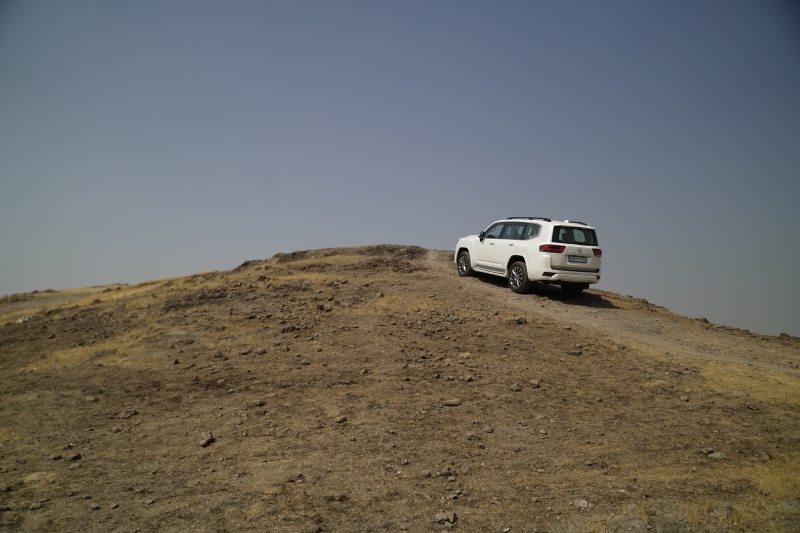
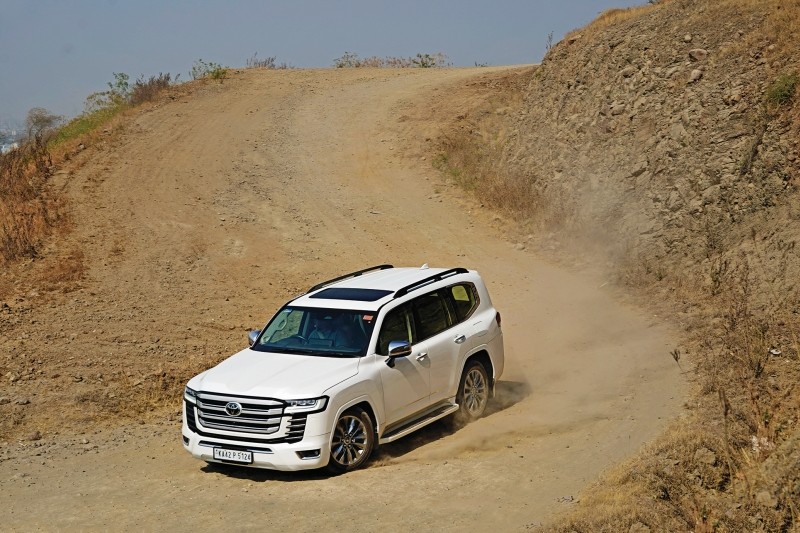
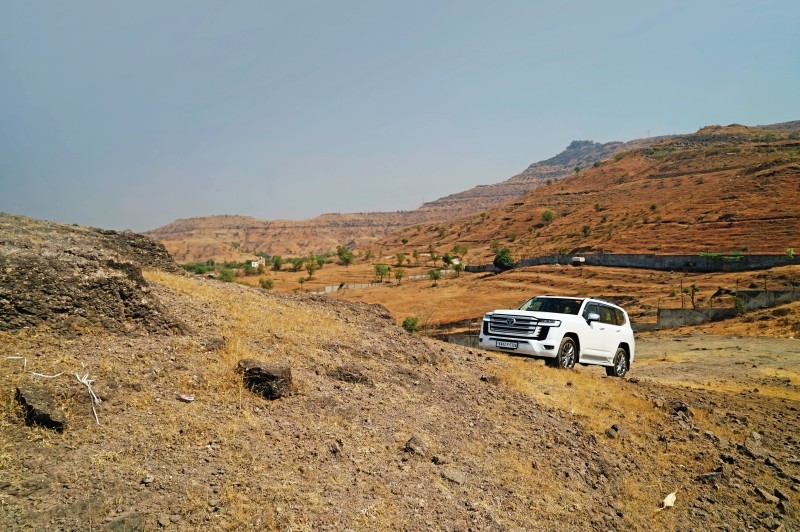
As we got to the hill road on the outskirts of the city, the tarmac vanished and was replaced immediately by dirt and dust, with some gravel thrown in for good measure. The most surprising aspect was how it continued unperturbed over the dirt, uphill, downhill, over small- and medium-sized rocks, and how swiftly, even adeptly, it changed direction to avoid the large-sized ones. I usually take note of the fuel efficiency and rev-counter antics to see how the engine deals with everything but, this time, I was so involved with the drive, the windscreen and the view outside—and the rate at which it changed—was enough cinema to keep me thoroughly focused, with the ding at 80 km/h being the only thing letting me know I was past that marker. What speedometer? Yes, truth be told, the combination of twin-turbo V6 and 10-speed auto ’box is slow to react to the need for speed, but once it buffers what is required, there is a surge of forward thrust and very little resistance. Get used to that, and all that was said and thought previously evaporates. This thing is fun, and it can go. I mean, really go when you need it to.
That said, the onboard computer and driver info-display show what is needed in terms of numbers. It is quite efficient for the behemoth it is. Less than 10 litres/100 kilometres on the open road when not pushing is excellent. The 0-100 km/h sprint time? Somewhere in the upper single-digit range, I didn’t take note. Top speed? About 200 km/h, it doesn’t matter. The Land Cruiser is beyond those numbers. Those are not parameters to be considered. What is a factor is the Rs 2.16-crore asking price, and that’s ex-showroom.
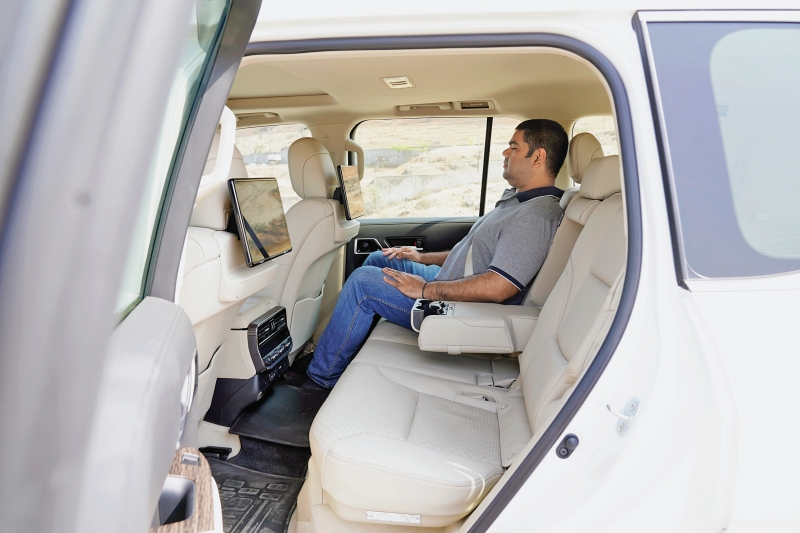
If you choose this over an Audi Q7, or a BMW X7, or a Mercedes GLS, or even a Range Rover, when people ask 0-100 and top speed, the answer is “Yes”. This is the Lexus LX for a few dollars less, so don’t let anyone tell you otherwise. It is a strong seller for Toyota globally and for good reason. It can do it all and make your day with how well it does it. It feels like it’s from a different time, yet it still feels very relevant and exceptionally special. It’s more Clint Eastwood the actor than the Gorillaz song. And it fits in everywhere. Almost.
Story: Jim Gorde
Photography: Sanjay Raikar








Leave a Reply