


Petrol + Electric = Hybrid
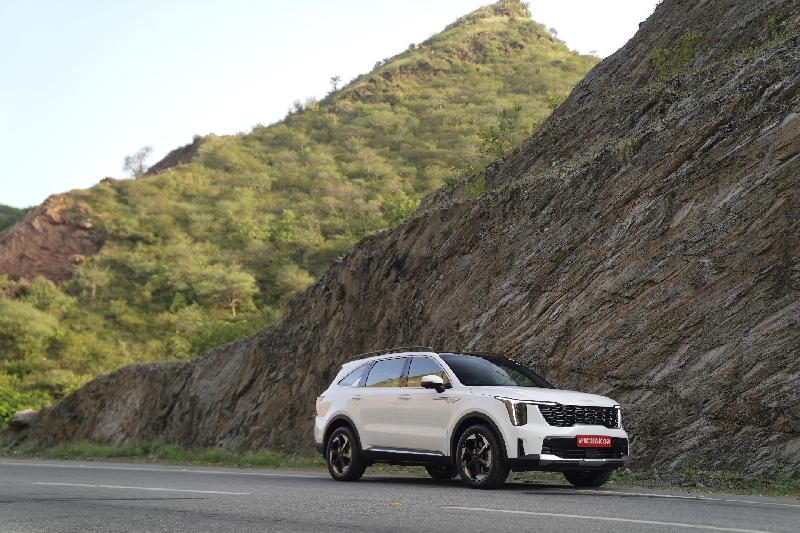
The age-old formula works and works well. It’s been tweaked, as I would find out later that day under an even hotter Udaipur sun. The Sorento Hybrid is Kia India’s first of its kind and a segment-first as well, with the option of front- or all-wheel drive making one sit up and take notice. The former starts from Rs 29.49 lakh with the latter starting from Rs 38.99 lakh.

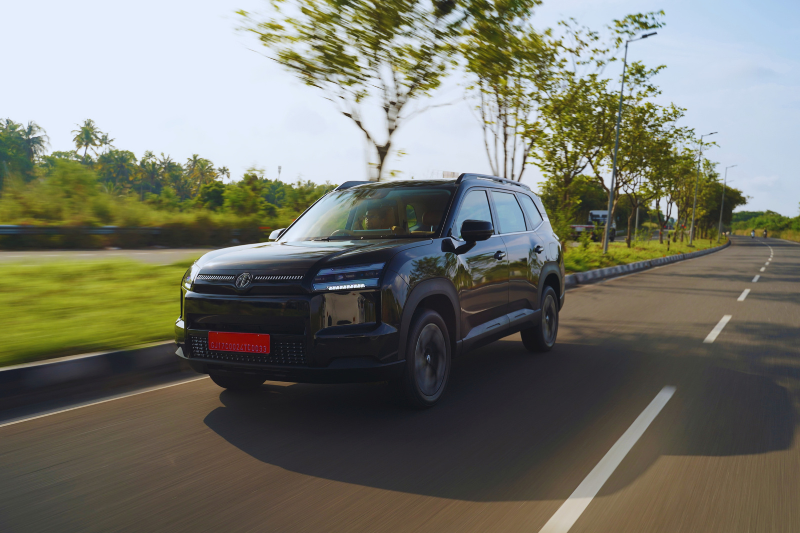
The styling is identical to the Sorento diesel save for the “HEV” badge suffix on the bottom left of the tailgate. The wheel design is also the same: 19-inchers with 235/55 rubber from Vredestein’s Giugiaro range of designer radials. There are a few changes inside, though. The Sorento HEV does not get a “Normal” drive mode because the hybrid drive relationship is standard.
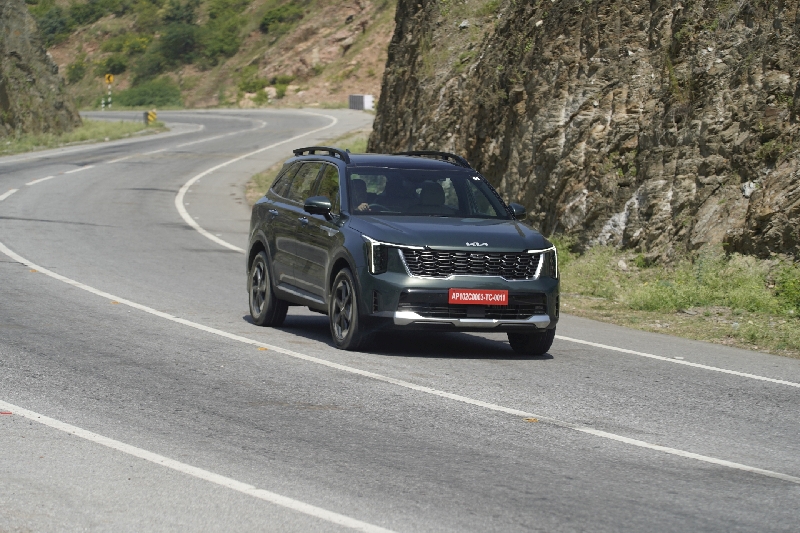
The battery pack is a 300-volt unit with about 1.5 kWh energy density. Most of the usable range is in the 30 to 80 per cent bracket to extract the most efficient drive while optimising discharge-recharge cycles. This is not a plug-in, and the self-charging hybrid driveline means recuperating energy almost by any means necessary, including at the cost of momentum. I found that out when accelerating up to 80 km/h and lifting off on a downhill stretch with no traffic ahead for some distance. The HEV has a charge indicator with battery energy display below it (instead of the rev-counter as the diesel has), and that showed its recharge attempt. The engine cuts off barely three to five seconds later, but there was no noticeable free-wheeling. I used my foot to try and feather the accelerator pedal expecting the e-motor to kick in and carry forward the momentum—like many mild-hybrids and hybrids do—with minimal power needed—the engine kicked in. In fact, just about 15 kW (20 hp) and 70 Nm is all that is needed for a two-tonne vehicle to maintain 80 km/h with the engine off—something we’ve noticed in multiple vehicles across varied brands and segments. Speaking of power, the 1.6-litre turbo-petrol finally makes its Indian début with 180 hp and 265 Nm. It is joined by a 47.7-kW (65-hp) e-motor integrated with the transmission that has an equal lump of 264 Nm. On paper, that could be 529 Nm, but the combined peak figure is 175 kW (238 hp) and 380 Nm. However, those are just superficial numbers. It is the efficiency that is its trump card.
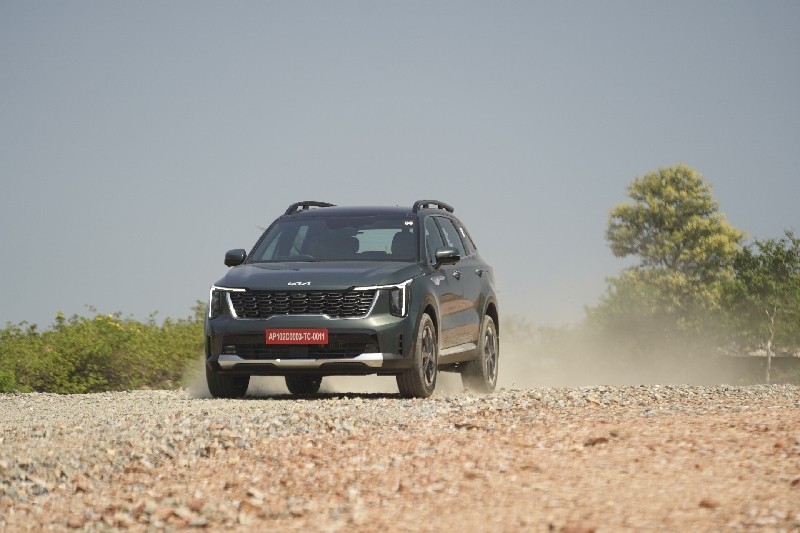
Moving around the parking lot and in urban or rather rural traffic conditions, the immediate torque from the motor makes the Sorento HEV quick to respond—quicker than the diesel, in fact. However, once moving, the remaining nine-tenths of the scale are in favour of the diesel. That said, when not prodding the right pedal, I saw close to 17 km/l. All said and done, I ended with an overall 13.5 km/l. Conversely, the diesel was an indicated 12.8 km/l and 10 km/l respectively. The indicated range, even with an eighth less of a tank, was nearly 850 kilometres.
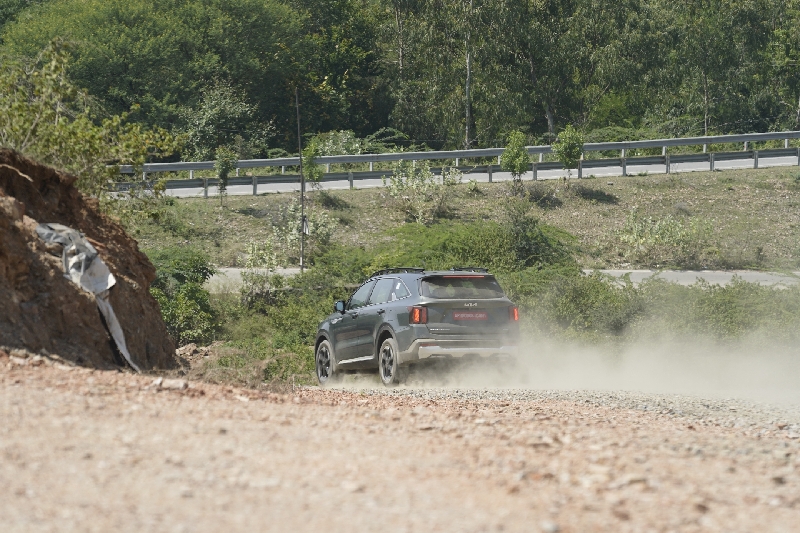
The Sorento Hybrid makes sense for families and those who want to be chauffeur-driven. When given the beans, the engine sound is audible and, frankly, louder than the diesel once past 4,000 rpm. It sounds like its long-stroke self—the 1.6 has a 75.6-mm bore and 89-mm stroke—when the revs pile on and while there is a raucous engine note; it doesn’t translate into a quick sprint. Clearly, efficiency is the focus here. The priorities are clear. It works best doing what it does best. And, driven like its rivals, it may just shine beyond what many expect. If anyone has a budget of Rs 30-40 lakh and wants a hybrid six/seven-seater, it would be worth their while to give this one a longer look and evaluate their priorities. Smart hand here, too, Kia.
Need to Know – Kia Sorento TGDI1.6 HEV HTX(A) AWD Six-seater
Price: Rs 40.19 lakh (ex-showroom)
Engine: 1,598 cc, in-line four, turbo-petrol
Max Power: 180 hp @ 5,500 rpm
Max Torque: 265 Nm @ 1,500-4,500 rpm
Battery: 270-volt, 1.49-kWh lithium-ion
Electric Motor: 47.7-kW, transmission-mounted
Max Output: 65 hp, 264 Nm
Peak System Output: 238 hp, 380 Nm
Transmission: Six-speed, automatic, all-wheel drive
Suspension: MacPherson strut front, multi-link rear
Weight: 2,050 kg (estimated)
Story: Jim Gorde
Photography: Sanjay Raikar










Leave a Reply