


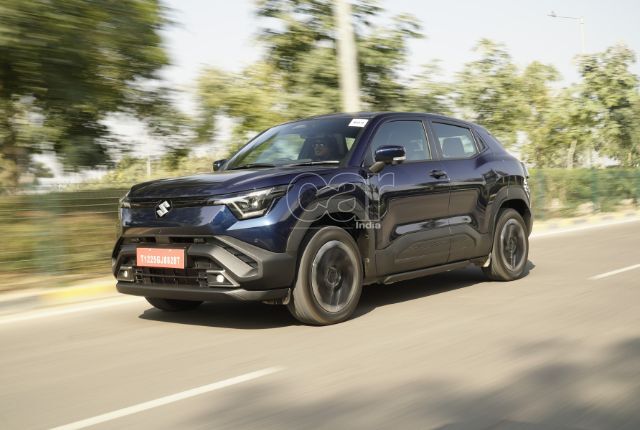
Can Maruti Suzuki’s first-ever production electric vehicle, the e-Vitara create shockwaves in the EV space despite it being late to the party? We sampled it around Delhi to find out just that
Words: Gaurav Davare
Photography: Sanjay Raikar
Even though some may be late to the party, there is a term called “fashionably late.” By that we mean, they still manage to be the life of the party and leave a mark on the overall environment. The same applies in the automotive space too, albeit the instances are rare. Well, Maruti Suzuki is one of those late entries to the electric vehicle space with its first-ever production electric vehicle, the e-Vitara first unveiled in India at the Bharat Global Mobility Expo 2025. Is this entry a little too late for the electric SUV to thrive, or can it be another example of the “fashionably late” term? We got to spend some time with it around the outskirts of Delhi to find out exactly that.
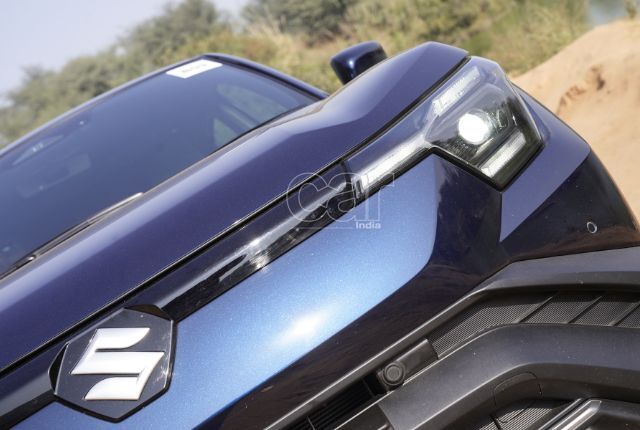
If there is one word to describe the trend of electric vehicle designs, that is “minimalism.” Fortunately, the Maruti Suzuki e-Vitara bucks that trend as it looks rather butch. There’s a litany of sharp creases, strong character lines, the flared haunch around the rear fender, and more importantly, a very prominent presence of cladding around the overall silhouette. The face itself looks nicely sculpted especially around the bonnet, with the sleek three-point LED DRLs wrapped around the LED headlamps giving it a menacing presence. In fact, if you look lower down the chunky front bumper, the grille has adaptive shutters to aid with cooling aerodynamics and range maximisation.
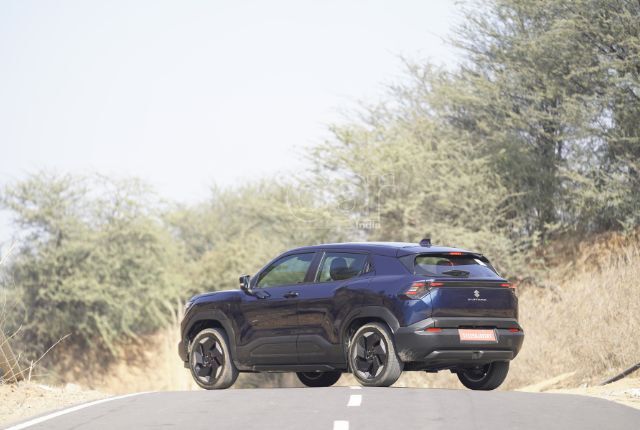
The aero optimisation doesn’t end there as the 18-inch wheel design also has efficiency as its focus. The rugged appeal is rounded off at the rear as there’s a chunky rear bumper, that is contrasted by a sleek set of LED tail lamps, with a shark-fin antenna and a roof-mounted spoiler adding a smidgen of sportiness to the e-SUV.
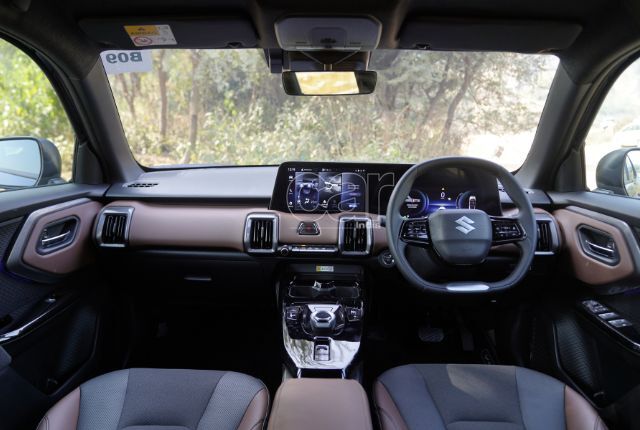
Step inside and you’ll notice that the e-Vitara has arguably the most un-Maruti Suzuki cabin layout yet. Not that this is a bad thing, as it is very well laid out, with a dual-tone black/tan theme and an all-new dashboard layout with a fit and finish that feels very premium. The finer details are even more interesting as there’s vertical AC vents, the steering wheel is a new two-spoke unit that feels easy to use and the Piano Black finish around the floating centre console looks fairly premium. The cherry on top is a healthy dose of physical controls covering all the important car functions.
The real highlight for this layout is the wide digital screen that houses the 10.1-inch touchscreen infotainment system and the 10.25-inch digital instrument cluster that is nicely integrated within the dashboard. The UI for the screens is also new, a bit more modern, but similarly easy-to-use like other Maruti Suzuki models. As far as features are concerned, it’s not a multi-page list of bells and whistles, but covers a lot of the necessary fundamentals for its segment. This includes wireless smartphone connectivity, a wireless phone charging pad, ventilated front seats, a 360-degree camera, a 10-way powered driver’s seat, multi-colour ambient lighting, a PM 2.5 air filter, connected car tech, as well as an Harman audio system.
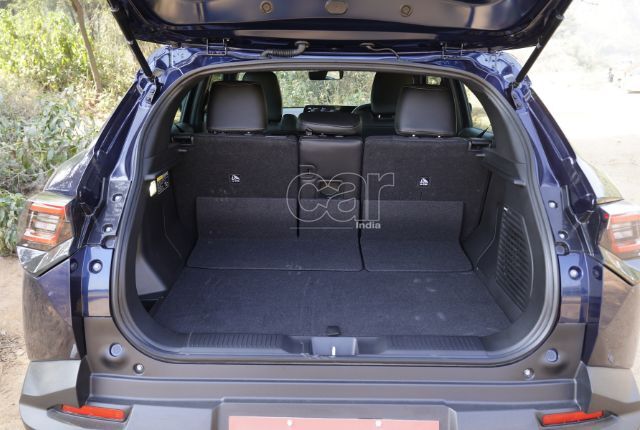
Being seated inside the e-Vitara feels nice for the front occupants as the semi-leatherette seats are nicely bolstered and can keep you well settled for long journeys, for the rear occupants, there’s ample legroom, kneeroom and headroom for a someone under six feet tall, with the flat floor allowing three averaged sized occupants to be able to be seated fairly comfortably. Taller occupants will find it a little on the limit, and the high floor means underthigh support is lacking. Those aren’t the only downsides as we wish there were physical controls to control the ventilated seats rather than digging into the touchscreen menus for it. Also it would’ve been ideal to have a sunroof that can be opened rather than it being a fixed unit. In addition to this, the digital instrument cluster has some margin for improvement in the amount of information available as it feels a little basic, with the resolution for the 360-degree camera feeling slightly pixelated at times.
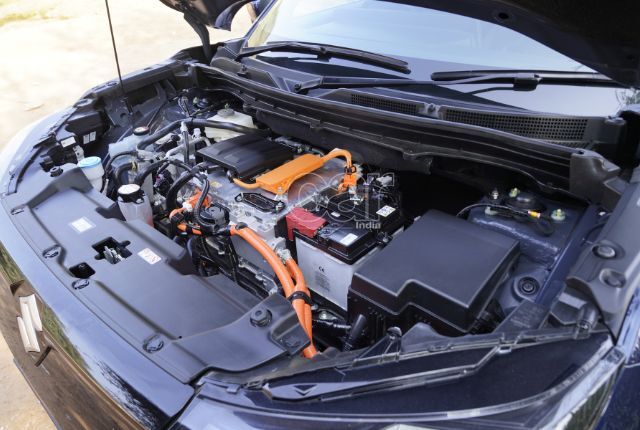
Now, to the real talking point of this e-SUV being how does it feel to drive it around the outskirts of Delhi. While we don’t have specific details of the electric powertrain of the India-spec model, we know that we will get the option of either a 61-kWh or 49-kWh battery pack. For reference, e-Vitara in markets abroad can be had with a 49-kWh battery pack front-wheel drive electric motor option that is capable of 106 kW (144 hp), and a larger 61-kWh battery-pack option with its electric motor putting out 128 kW (174 hp). There’s also an ALLGRIP-e electric four-wheel drive variant putting out 135 kW (184 hp) and 300 Nm, paired with the 61-kWh battery pack. We know that the India-spec electric powertrain figures will be similar to the one sold abroad, and the unit we’re testing is a front-wheel drive option with the 61-kWh battery pack that has a claimed ARAI range of 543 km on a single charge, and has AC and DC fast charging capabilities.
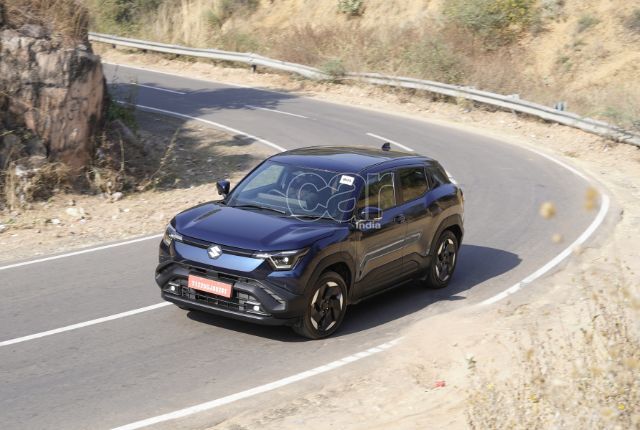
The first thought I had while driving the e-Vitara was that it feels very similar to an internal-combustion-engined Maruti Suzuki car with the positive bits such as the light, yet responsive steering feedback, impressive ride quality and easy-to-use nature, The electric powertrain’s delivery felt linear so no nasty surprises were in store while using the Eco, Normal and Sport drive modes. This makes for an easy transition from an ICE to an EV. Even though the ride is impressive, this isn’t the kind of EV I’d recommend if you prefer spirited driving as there are hints of understeer in high speed sections. Under braking, even though I could feel the ideal bite point, it would’ve been ideal to have better stopping power. Also while operating the regenerative braking feature, while there is a hotkey to turn it on or off, it would’ve been nice to have paddles on the steering wheel to adjust the regen levels rather than having to dig into the infotainment menus to do it.
The Maruti Suzuki e-Vitara is decently specced on the safety front with things like seven airbags, all-wheel disc brakes, an electronic parking brake with auto-hold, a tyre pressure monitoring system, ABS with EBD, as well as front and rear parking sensors. Of course, how can we forget the Level 2 ADAS suite of safety assists. Trying out things like adaptive cruise control, lane keeping assist, as well as blind spot alerts, it felt like these assists were well tuned for Indian conditions, so it’s unlikely to give you sudden intrusions.
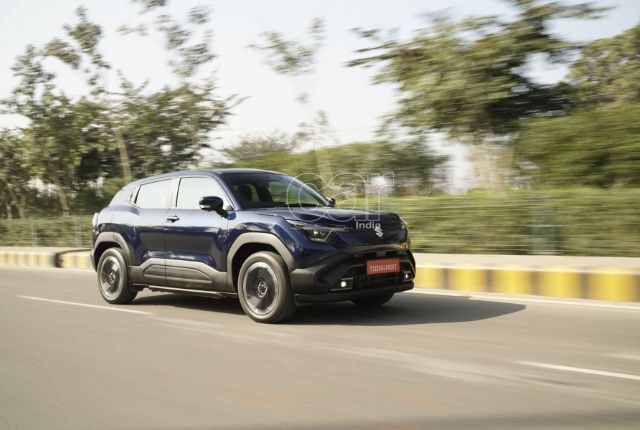
How does the ARAI-claimed range of 543 km hold up in the real world? We started our drive with 462 km worth of range on a full charge and didn’t really do extensive long running considering our limited time with it, and ended our drive with around 415 km still left. So getting between 350-400 km on a single charge if you drive it judiciously should be achievable. Also, the carmaker is offering further benefits to the ownership experience with things like a Battery as a service (BaaS) subscription scheme similar to what JSW MG Motor India offers with its lineup, a home charger installation before the vehicle delivery and are aiming to install over one lakh charging points across India by 2030.
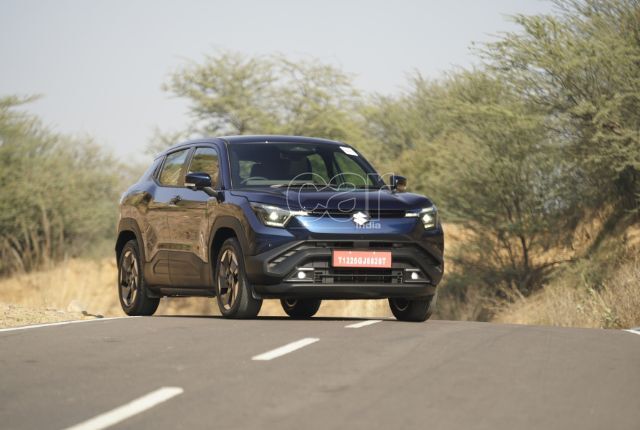
At the end of the day, can the Maruti Suzuki e-Vitara bring that Maruti Suzuki magic to the EV space? Well, in terms of driving experience alone, it has all the good points of a Maruti with its easy-to-use and dependable characteristics. While it covers the fundamentals in terms of features, it isn’t quite loaded for its segment. So how it is priced will play a key part on how this electric SUV fares in this space. If Maruti Suzuki gets things right, then the e-Vitara can be a formula to consider for a family-friendly commuter.







Leave a Reply