


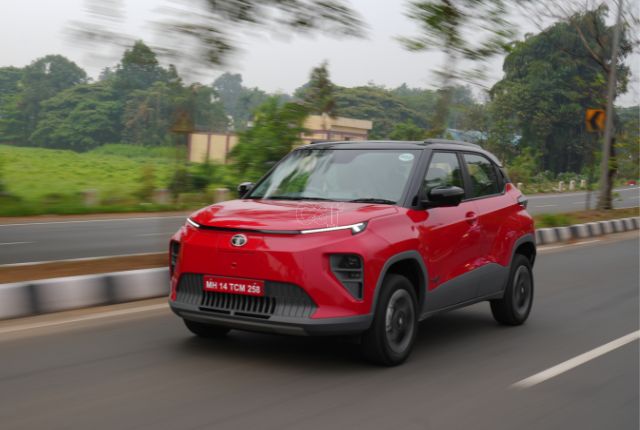
How comprehensive is Tata’s first update to the Punch.EV?
The Tata Punch.EV has a first-mover advantage of sorts, as the only other sub-Rs 10 lakh electric sub-compact SUV, the Citroen eC3, is rarely seen on Indian roads. With its first update since its Jan 2024 debut, Tata aims to further solidify the Punch.EV’s position, and bring it out of its elder sibling, the Nexon.EV’s, shadow.
Visually, the new Punch.EV is distinct from its predecessor, and subtly different from its current-gen ICE-equipped brethren. So, no connected DRLs or grille element here; the clean fascia is punctuated only by the centrally mounted charging inlet, and grey air dam and silver-finished skid plate below.
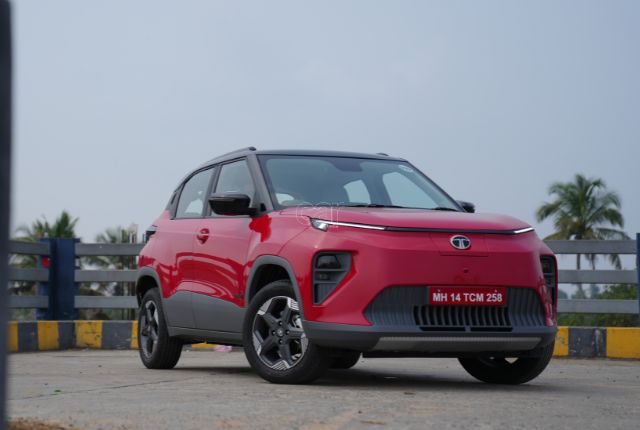
From the side, the Nexon.EV-based 16-inch alloys are retained, though there’s a drum (instead of a disc) at the rear, likely a trade-off considering the inclusion of regenerative braking. The rear, though, with its connected LED tail-lamps, is identical to the regular Punch.
Moving inside, there’s the familiar two-tone dashboard as on the ICE-equipped Punch. Elements like the two-spoke steering wheel, touch-based a-c controls and 10.25-inch screens for the infotainment system (with wireless Apple CarPlay and Android Auto) and instrument cluster are retained. A thoughtful addition is the high beam alert, prompting you to lower your headlight beam after a minute at speeds between 10 and 40 km/h. Further additions include over-the-air (OTA) updates, and voice commands that support multiple voice assistants.
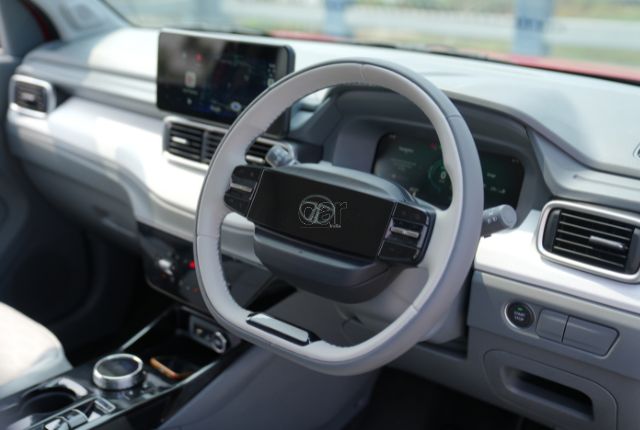
The Punch.EV’s front seats are ventilated and get extended underthigh support, like on the ICE model, but are only manually adjustable. Even the steering wheel gets tilt, but not telescopic, adjustment. The sunroof, meanwhile, feels unnecessary in our tropical weather, and should have strictly been an optional add-on.
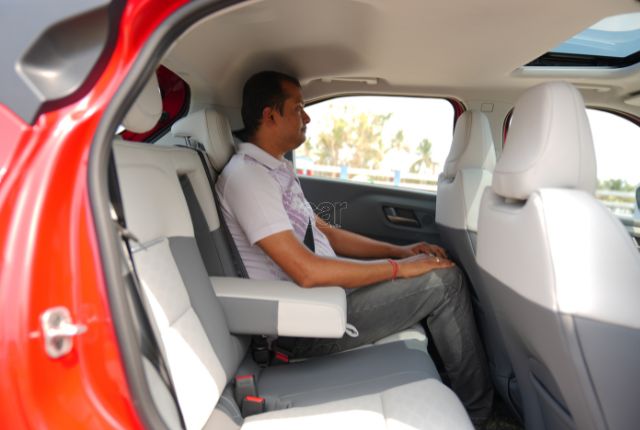
The rear seat, too, is best suited for occupants of average height. With the driver’s seat adjusted to my six-foot-two frame, my knees were digging into the seat back. My head, too, felt just one pothole away from bumping into the roof. Additionally, though the rear offers three-point seatbelts for all occupants, it gets neither a split folding function, nor cupholders behind the swivelling middle backrest/armrest. The final internal quirk is Tata’s seatbelt-activated handbrake release, as on recent Tatas like the Sierra, a novel safety feature that locks the real wheels till the driver’s seatbelt is secured.
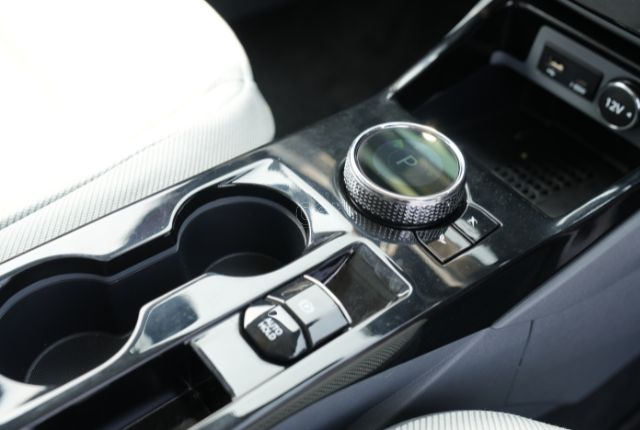
Seatbelts clicked in, dial twisted to “D”, and the Punch.EV starts off in City mode by default, with the Sport and Eco available via buttons on the centre console. Being an EV, the pedal response is instant, which, coupled with its small size and zippy steering, means it’s best suited for the city commute, easily capitalising on gaps in traffic. And yet, it has a sporty streak: 40 km/h from standstill comes quite rapidly, with 100 km/h coming in at just over 10 seconds despite progress tapering a bit past 80 km/h.
In heavier traffic, where Eco mode is warranted, you’ll find the pedal response proportionally muted, despite which you won’t find yourself missing out on overtaking opportunities, or needing to excessively modulate your right foot. Switch to Sports mode, meanwhile, and the 129 hp (95 kW) and 154 Nm come out to play, allowing you to hit 100 km/h from standstill in just under nine seconds. The steering wheel, too, weighs up just enough to allay any sudden inputs, as this tall-boy EV is prone to significant (though not alarming) body roll.
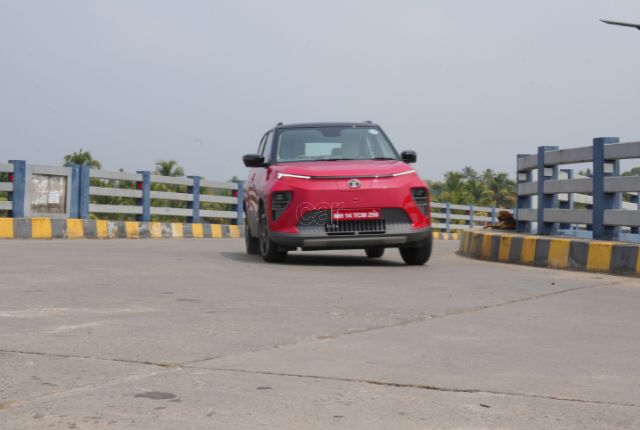
Speaking of which, the suspension travel and 195-mm ground clearance felt adequate on our relatively short first drive experience on Kerala’s silky smooth roads. A clearer picture can only emerge once we’ve put it through the wringer on the pothole-riddled streets around home base.
But speed is nothing without control. Despite the disc-drum brake combo, the braking seems progressive, with a controlled pitch despite the tall stance even in panic-braking situations. This is complemented by the multi-mode regenerative braking (three modes, plus off), which Tata says has been recalibrated for the Punch.EV’s revised powerplants, especially the larger 40 kWh variant. The default level of regen is one, with level two suited for moderate traffic, and level three for heavy stop-and-go situations, or when going downhill. That said, level three felt quite natural in city traffic too, with speed being shed progressively. And yet, the so-called “one pedal driving” felt difficult at anything over pedestrian speeds.
Now, the short while we spent with the Punch.EV wasn’t enough for a comprehensive range calculation. But in the 70 or so kilometres we covered, the range dropped by 21 per cent, so Tata’s claimed figures (355 km for the 40 kWh variant) shouldn’t be too far off the mark in the real world. Additionally, Tata claims a 10 to 80 percent charge time of 30 minutes via the 65 kwh DC fast charger, though that number drops to about five hours and over fourteen hours when charging via the 7.2 kWh and 3.3 kWh AC home chargers, respectively.
Summing up, in a developing country like India, where most households have a single car, the Tata Punch.EV makes a strong case for itself by ably combining performance chops, family practicality, and a reasonable price tag. But Tata’s masterstroke is the BaaS scheme, which nets you the car at just Rs 6.49 lakh, with the battery available at a nominal Rs 2.6 per km.
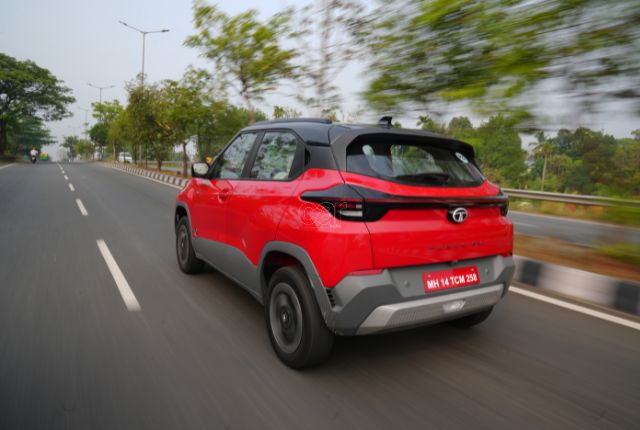
Yes, the Punch has a few peculiar misses, like the lack of powered seats, or a sealant and inflator kit instead of a spare tyre or even a space-saver. However, if your driving is mostly in and around the city, and you want SUV styling with electric convenience, the Tata Punch.EV would be a natural choice for you.





Leave a Reply