


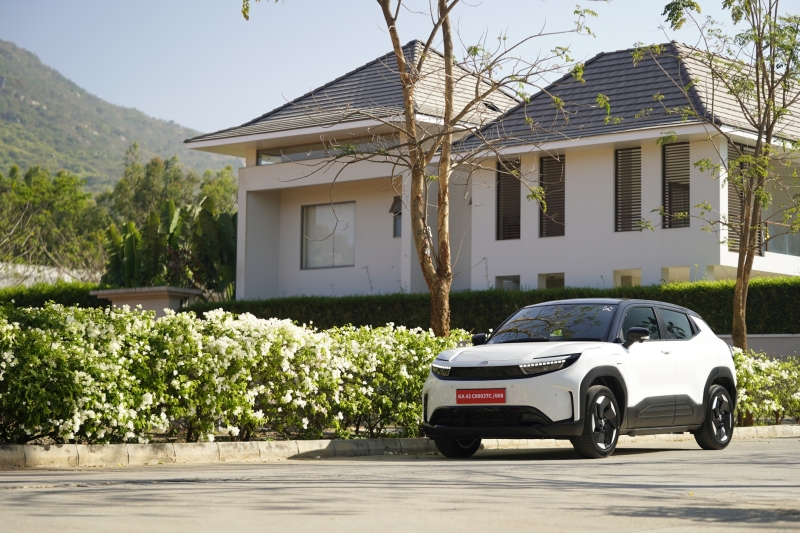
Toyota Kirloskar Motor’s first battery electric vehicle (BEV) in India is the Urban Cruiser Ebella, and it is a shared platform with the India’s number-one automaker. We drove it in Bengaluru to bring you this review.
You know electric is about to get a major push in the country when the world’s leading car maker and India’s leading car manufacturer both ready their BEV wares for public consumption. The latest from the former is the new Urban Cruiser Ebella—it even sounds like something that will go viral. Will it just be online, or does it make an impact in the real world, too? We headed from the Bengaluru airport and city life to the open countryside for a drive.
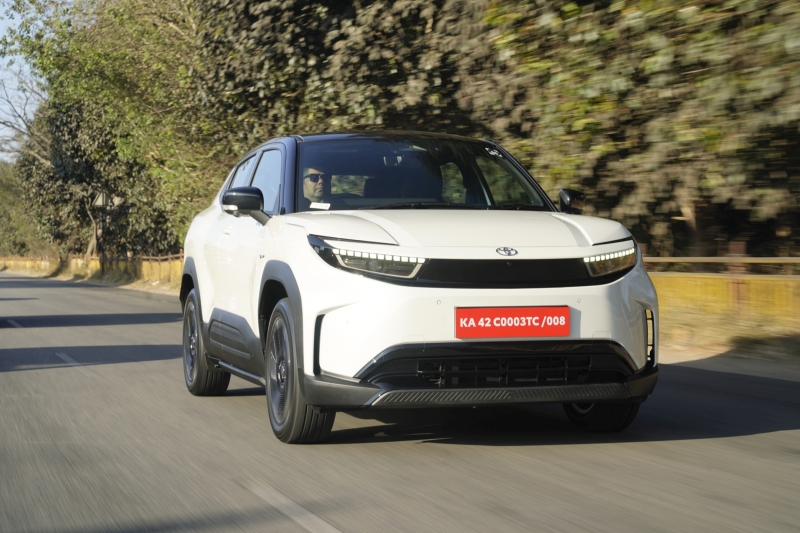
The Ebella is a mid-size sport utility vehicle (SUV) set to take on what is becoming a popular segment. At 4,285 millimetres long, 1,800 mm wide, and 1,635 mm high with a 2.7-metre wheelbase, it is in the ballpark of the MG Windsor and VinFast VF 6, while just falling a few millimetres short of the Mahindra BE 6 and the Hyundai Creta EV, which are its primary competitors—apart from its stablemate, the Maruti Suzuki e Vitara, of course.
With the cut-throat competition and sensitive pricing aspects, Toyota seems to have believed it wise to test the waters of the pure electric segment which is being pushed in India but is crashing globally. The “bZ” series models sold internationally could only be considered as a limited-number special introduction for those who want something more premium. That said, the Urban Cruiser Ebella looks to be priced in the Rs 20-25 lakh bracket. Toyota will introduce just three variants to begin with: E1, E2, and E3.
The E1 is the base model with a lower-capacity 49-kWh battery pack and an electric drive motor producing 106 kW (144 hp). The E2 and E3 get a 61-kWh battery pack and a more powerful 128-kW (174-hp) motor. Both configurations are front-mounted, and both churn out a claimed 193 Nm of torque; the motor is listed on global websites as producing either 189 or 193 Nm.
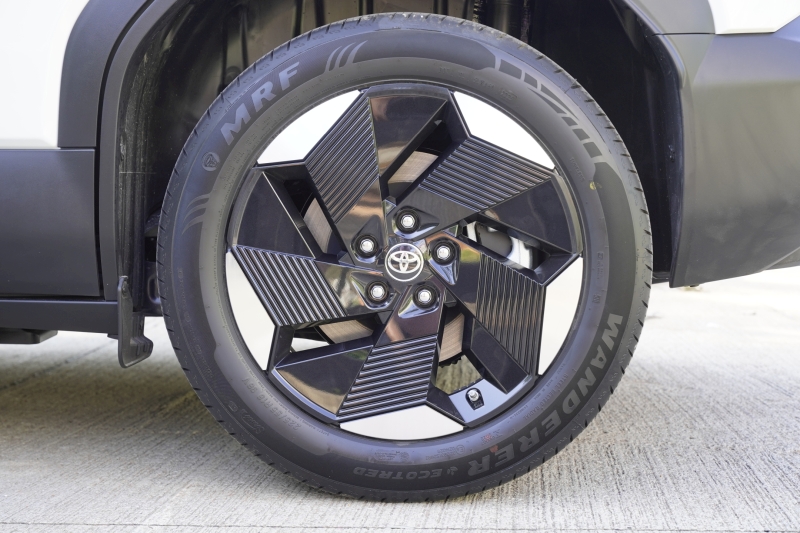
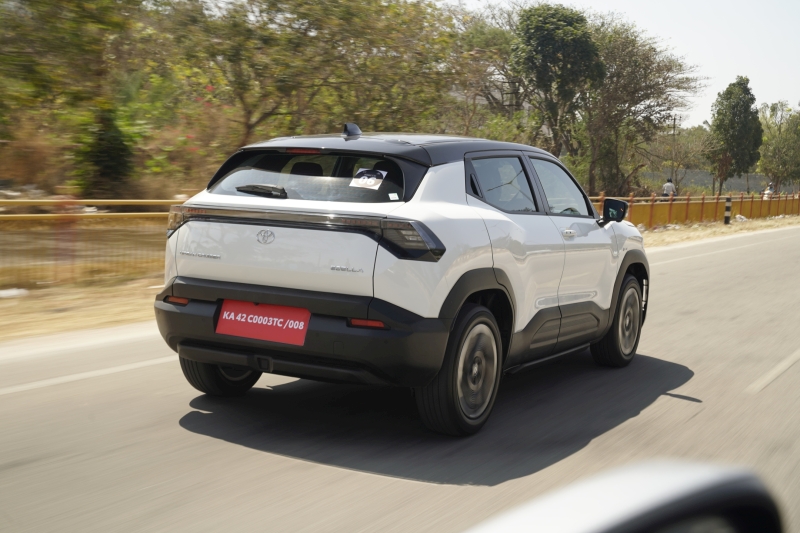
We were given the Ebella E3 in a traditional shade of white. The head-on stance reminds me of the first Toyota Urban Cruiser in India, at least in terms of proportions, albeit with modern design elements including a set of LED projector headlights and a new Crown/Prius-like hammerhead-shaped closed grille—its most pertinent visual connection to Toyota’s modern design language globally. The platform, of course, is shared with Suzuki’s Heartect-E, which will make it strong and durable. The high-voltage battery pack is mounted in the floor and powers the traction motor at the front, which is equipped with a single-speed transmission. And this one has 18-inch wheels with 225/55 rubber.
Inside, the space is quite good, and the layout and ergonomics are excellent, making it an easy vehicle to get used to quickly. What’s quite unconventional is the drive selector—a round dial that needs to be pushed down for neutral, twisted left for reverse, and right for drive. Look back up ahead and the twin 10-inch screens are prominently in view. The centre touchscreen is a 10.1-inch unit, and the driver display is a slightly larger 10.25-inch unit, but segmented for ease of visibility. There is a lot of information from charge level, driving range, media, navigation, and more to cycle through, with three options available for the two side segments flanking the main centre display, which is mainly for the speed and information from the driver assistance systems.
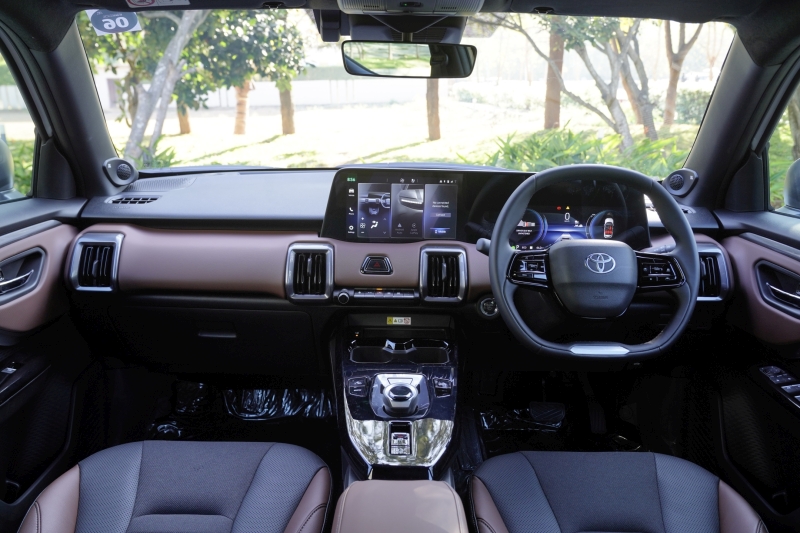
There is a lot of kit in here from the infotainment with wireless Android Auto or Apple CarPlay smartphone connectivity, wireless charging, and a nice floating centre console with more storage room beneath it. There is a mix of buttons on the door panel, steering wheel, and centre console. Most of the major climate controls are available via buttons, but the seat ventilation is activated via the centre touchscreen. All in all, there are some nice appointments and touches which make the Ebella seem like a credible new alternative for those seeking an electric mobility solution for daily use.
Right, drive time. It has three modes: Normal, Sport, and Eco. I start in the Normal mode. It shows an indicated range of 491 kilometres on 99 per cent charge. Our route will take us from the airport hotel through a bit of urban jungle, some highway, and on to a narrow but more secluded two-lane B-road which heads towards the Nandi Hills. The indicated real-time efficiency is just 3.8 km/kWh. That’s quite terrible, but it is justified from standing there waiting for us to get in, screens and air-conditioning powered on. I know I can get it to at least 5.5 km/kWh. Challenge accepted.
The ride quality and feel are exactly what one would expect of a Japanese mid-size creation meant to be an all-rounder, built with a competitive price (and margin) in mind. The Ebella’s cabin feels like that of a conventional combustion car’s—the wheel doesn’t feel artificially weighted, the door panels feel almost old-school, and—appreciably—hold very conventional controls for the wing-mirrors, door locks, and windows. Good. I look up and see a rather large sunroof with a manual sunblind. I look down and see a two-pedal set-up like a proper automatic. Off we go, then.
The motor is quick to respond with a forward acceleration that is neither urgent nor brisk. However, it gets moving adequately and does not feel wanting for its weight. The sound insulation is quite good, and there is an added sense of calm in the cabin. No tailpipe and engine means no exhaust emissions and just a minor, almost inaudible combination of a hum and a whine of the motor doing its job. Toyota didn’t share claimed figures for the zero to 100 km/h acceleration nor for the top speed, but it will do the sprint in less than 10 seconds and stay between 80 and 100 km/h with relative ease. Coming to energy regen, Toyota says there are four levels of regeneration, but the console button only turns it on or off; levels have to be selected from the screen.
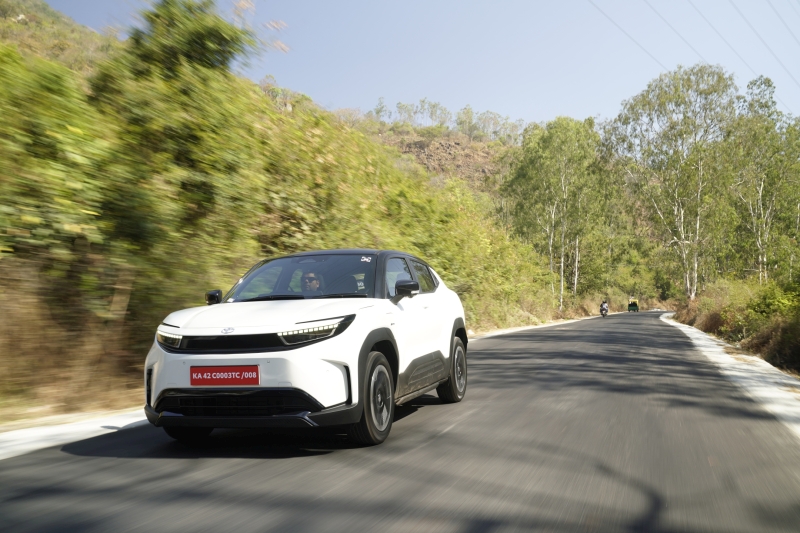
Once we got to the Hills, we were in for some nice bends of freshly laid tarmac, complete with elevation changes. It felt pretty nimble going around the curves, too. Somewhat engaging but not quite indulgent, it behaves itself and covers the miles quickly. We soon turn and head back. The ride quality is supple enough to soak up bumps with a thud or two filtering in audibly when going over some more damaged road sections. The brakes do their job, and the assistance systems, a big deal these days, also work well.
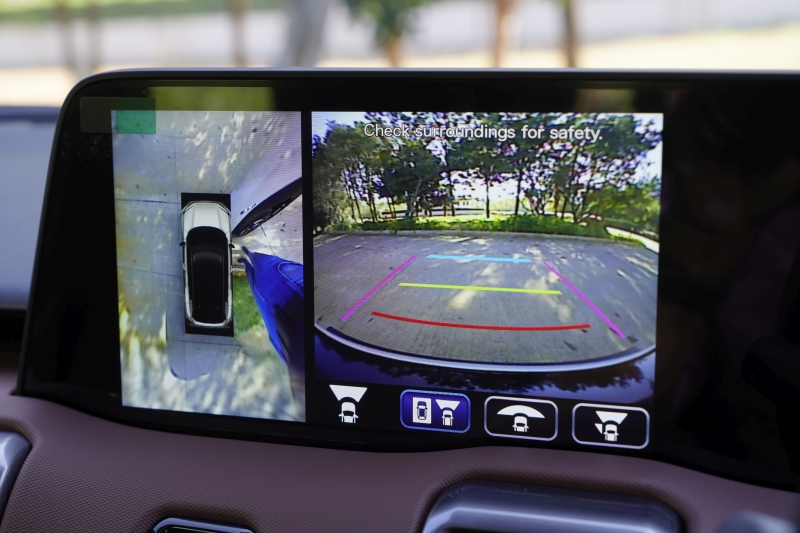
The Level 2 ADAS brings adaptive cruise control with vehicle distance presets. The lane-keep works noticeably, and the alertness of the sensors is commendable, if not more proactive than most. The blind-spot monitor is unique in how it subdues the sound of the turn-indicators to warn the driver of a potential collision. There is also the 360° display, which shows the proximity of other road users. The reverse camera does its job, but the quality of the camera feed on the screen is of a lower resolution, and that feels a few generations behind. That was one niggle; the other was the late morning sun’s reflections off the piano-black panels on the centre console that dazzled me at some angles. Everything else was on point and hit the markers. Oh, and I finished with an indicated 6.2 km/kWh efficiency and 380 km left with 81 per cent charge remaining. Not bad at all. I admit the return drive was done in Eco mode, with regen turned off, not on, as there was less “engine braking” feel slowing me down, thus not requiring more pushes of the right pedal.
The price will be a factor, obviously, with consensus in the crew being around Rs 22-25 lakh for the top E3 model. Prices should start just below Rs 20 lakh for the base E1, or so I believe. And, no, there is no word on the dual-motor all-wheel-drive version for India.
Need to Know – Toyota Urban Cruiser Ebella E3
Price: Rs 22-25 lakh (estimated)
Battery Pack: 61-kWh, 400-volt, lithium ferro phosphate (LFP)
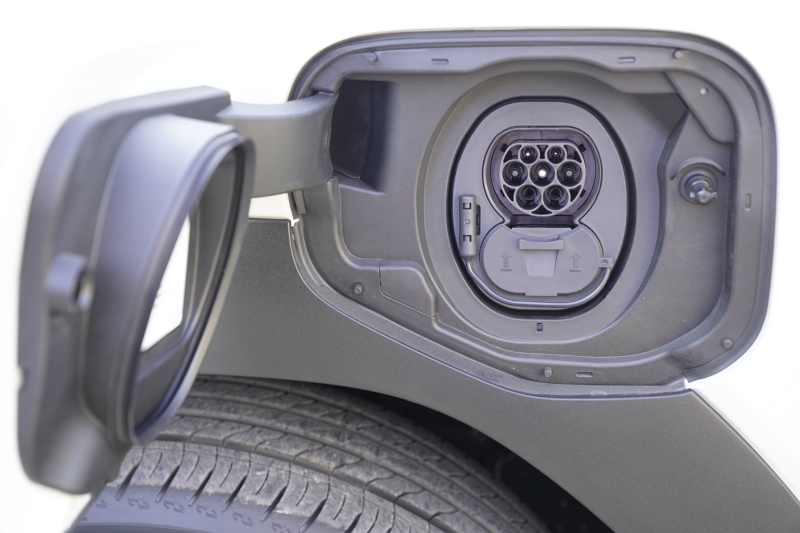
Charge Rate: 70 kW DC (max), 45 mins (10-80%)/11-kW AC, 5 hrs 30 mins (10-100%)
Electric Motor: 128-kW, permanent-magnet synchronous
Peak Output: 174 hp, 193 Nm
Transmission: Single-speed automatic, front-wheel drive
Suspension: MacPherson strut front, multi-link rear
Weight: 1815 kg
Story: Jim Gorde
Photography: Sanjay Raikar






Leave a Reply