


The Kia Carens Clavis EV picks up in an instant with a thickening surge increasing vehicle speed with alacrity. There are three drive modes as well—Eco, Normal, and Sport—each of which brings about a different theme for the digital driver instrument binnacle. As expected, Eco mellows out the response. Normal is a bit quicker and more al dente in traditional pasta terms. Sport seems to allow more of the motor’s capability and makes for a more immediate and far more telling response. Remember, even electric motors have “rpm” which is actually “rotations per minute” in their case. The drive ratio is a steady 10.65:1. In Sport, the surge is quicker and standstill to 50 km/h takes barely a couple of seconds. It’s pretty quick in Normal mode, too, which, I suspect, will be the most used mode, if not Eco. After all, this is a brilliant lateral elevator-type ride which takes one from where one is and comes to a stop where one needs to be, albeit while being seated in high comfort.
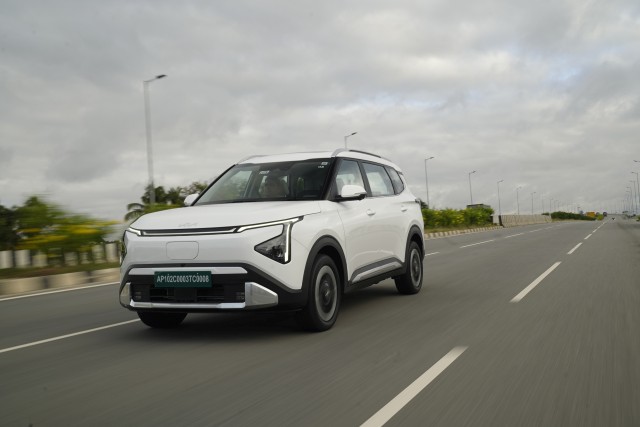
When it comes to the ride quality, the Clavis EV feels planted and quite sorted, not just at urban speed, but also at highway speed. One of the most outstanding aspects is the feature that displays remaining range. It shows charge level, yes, but there’s more. It shows a graph with the minimum possible range on one side and the maximum possible range on the other, each changing per the state of charge (SoC) of the battery pack. The bar in between those shows present estimated range and is a dynamic figure that updates every few minutes or so, giving a more accurate estimate of how much range one may truly expect. I saw a low of around 6.5 km/kWh and a high of 10 km/kWh which, with the 51.4-kWh battery pack we have here, translates into between 334-514 kilometres. There is even an “EV” option within the main centre display that shows more detailed use statistics. That said, there are more ever-present variables, road characteristics, uphill or downhill, wind speed and direction, load—occupants and cargo—in the car, tyre pressure, regeneration mode, and, last but not least, driving style.

One important feature is the i-Pedal—essentially one-pedal driving. This is automatically enabled in the highest regen mode. There are four in total, each offering a progressively higher level of braking upon lifting off the accelerator. The low figure discussed above was in mode two, whereas the high figure was with mode four. Recuperation will vary with the slope of the road surface and how much the vehicle coasts on an empty stretch.
The Clavis EV also has a full ADAS Level 2 suite. That broadly includes smart cruise control with stop and go as well as preset distance levels, collision warning and avoidance assist, active lane-keep assistance, blind-spot warning and a camera feed in the display-dial, rear cross traffic alert, and automatic braking, among other useful equipment and conveniences.
All said and done, the Kia Carens Clavis EV presents itself as a higher quality, more usable, and much more practical and versatile electric mobility solution than what we’ve become used to thus far in the seven-seat EV space around Rs 20 lakh. It’s refined, it’s quiet, and it offers consistent and predictable performance, with excellent ergonomics and a thoughtfully laid-out cabin and interior. Kia also offers the Kia Connect App and has a ready network of charging partners, making it easier to plan your trip should the need to leave the city arise.
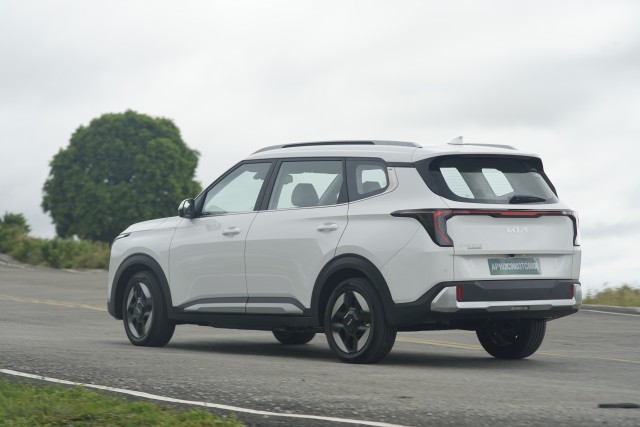
Story: Jim Gorde
Photography: Sanjay Raikar
Need to Know – Kia Carens Clavis EV HTX+ ER
Price: Rs 24.49 lakh (ex-showroom)
Battery Pack: 400-volt, lithium-ion, 51.4-kWh
Motor: Oil-cooled, permanent-magnet, synchronous
Output: 126 kW (171 hp), 255 Nm
Transmission: Single-speed automatic, front-wheel drive
Suspension: MacPherson strut, twist beam rear
Charge time: 39 mins (10-80% @ 100-kW DC), 4 hrs 45 mins (11-kW AC)
Weight: NA
















Leave a Reply